



Damiana and Rui chat about what they like to do during different seasons of the year in Portugal. (Recorded in September 2024)
Estações do Ano
Seasons of the Year
November 14, 2024
 Damiana
 Rui
Rui

Horários Tardios
Late Hours
September 8, 2024
Luís describes his sleeping habits.
 Joel
Joel Luís
Luís

Ainda Vamos a Tempo!
We’re Still On Time!
June 26, 2024
A father who’s always early vs. a daughter who’s always late… It’s about time (pun intended) for an episode like this! Language focus: words and phrases related to time and numbers.
 Eliana
Semana Produtiva
Productive Week
February 7, 2024
A man talks about what he did yesterday and today. Notice how different forms of the past tense are used throughout the story.

O Concerto Da Gisela
The Gisela Concert
October 11, 2023
Pedro and Rita make plans to go to a concert.
 Mónica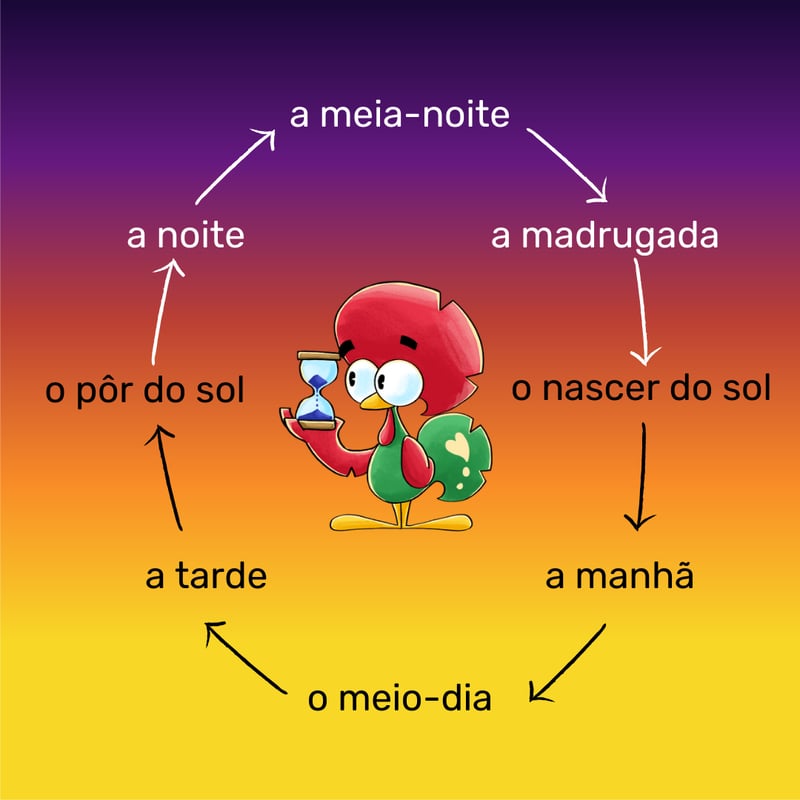

Times of Day in Portuguese
June 20, 2023
Let’s go over the times of day in Portuguese! These are the from sunrise to sunset: – from until 6am/dawn (around ) – from about 6am until – from noon until about 6pm (or around when it gets dark) – from about 6pm to midnight
O Tempo e as Estações
Time And Seasons
April 14, 2022
A teacher leads his class in a lesson about the calendar. The students answer questions about time, dates, seasons of the year, and weather.
 Eduardo
How to Say Large Numbers in Portuguese
September 23, 2021
In the next couple lessons, we’ll let you practice with large numbers, such as those in the ten-thousands and hundred-thousands. A few reminders: – Remember that 100 is cento when it’s part of a number (i.e. followed by e) – Remember that 100 is just cem when it’s by itself (i.e. not followed by e) Here’s […]

Por Quem Me Tomas?
Who Do You Take Me For?
November 13, 2020
Miguel has a short conversation with Bruna before heading to the grocery store. Notice how the preposition “por” is used in a variety of different contexts throughout their dialogue.
 Natacha
 Pedro
Pedro
Talking About the Past with “Haver”
August 21, 2019
The Portuguese often use the verb to discuss the past, whether it be minutes, hours, days, months, or years. In these contexts, haver is an impersonal verb, meaning that it doesn’t take a particular subject and is always used in the present tense form of the third-person conjugation: Normally há means there is or there are. However, […]

Adverbs of Time: Almost, Always, etc.
February 21, 2019
can tell us when, how often, or for how long an action happens. As with most other Portuguese adverbs, adverbs of time are always invariable. In this lesson we’ll start with some of the most frequent adverbs of time in Portuguese, which are: Quase We dealt with quase in the previous lesson, as an adverb […]

Adverbs of Time
February 20, 2019
In this lesson, we’ll look at more examples of Remember: adverbs of time are always invariable, meaning they do not change form to match the gender or number of the word they reference. Cedo Tarde
Translator
Hide
0/255