

In Compound Tenses 1, we focused on in the indicative and conditional moods. Now we’ll cover compound tenses in the , as well as . Don’t worry, the basic formula is still the same 😉: auxiliary verb ter + past participle of the main verb. Quick Overview Here are the forms we’ll cover in this […]


Compound Tenses in the Subjunctive Mood
August 21, 2023

Compound Tenses in the Indicative and Conditional Moods
August 21, 2023
Up until now, we’ve mostly been working with simple tenses, but now it’s time to explore the various compound tenses in Portuguese. This Learning Note is just an introduction to the general concepts — we’ll cover each one in more detail as you progress through the Unit. What Are Compound Tenses? A Portuguese verb form […]


As Recomendações Da Sara
Sara's Recommendations
August 9, 2023
Sara gives Ana recommendations for new TV series to watch.
 Eliana
 Mónica

The Verb Saber
August 1, 2023
The Portuguese verb has two different meanings. Most of the time, it means 🧠 to know, but did you know in certain contexts it can also mean 👅 to taste? Saber is conjugated in the 3rd person singular in both sentences, so it’s written exactly the same, but with an entirely different meaning. In the […]

Saber vs. Conhecer
July 30, 2023
The verbs and cause a lot of confusion for Portuguese learners. If you translate them into English, both mean to know, but in Portuguese you also have to pay attention to the context in order to know 😉 which one to use. Saber: Talking About Information You Know We use saber to talk about facts […]

A Few More Common Irregular Verbs
July 18, 2023
If you remember the Common Irregular Verbs unit, this is part 2! As you may remember, Portuguese verbs can be irregular in the root, the ending, or both, and they are often irregular only in certain tenses. Here’s an overview of most of the verbs we’ll cover in the following Lessons. For now, we’re continuing […]

Indirect Speech
July 12, 2023
In Portuguese, when studying narrative texts, we make the distinction between direct and indirect speech. Direct speech is spoken by a character, while indirect speech is spoken by a narrator, in the third-person. Each is clearly defined by different punctuation, but the verb tenses and conjunctions are different too. In real life, everything is technically […]
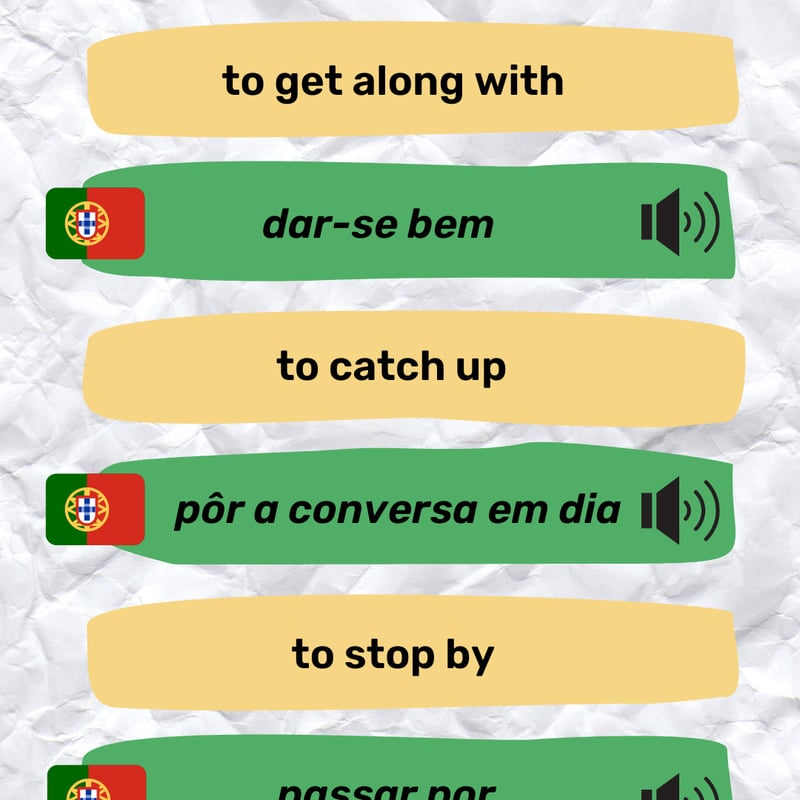
English Expressions in Portuguese
June 28, 2023
One challenge of learning Portuguese, or any language, is that you can’t simply translate literally. Each language has its own conventions for how to word different concepts. This is known as idiomatic language. In this Learning Note, we’re focusing mostly on how to translate English “phrasal verbs” into Portuguese. (For other types of idioms, check […]

Rita E Raquel Vão Ao Cinema
Rita And Raquel Go To The Movie Theater
June 21, 2023
Rita and Raquel talk about their plans as they get ready to go out for the evening. Listen for regular -ar verbs conjugated in the present tense.

O Miguel Faz A Vontade À Gisela
Miguel Humors Gisela
May 17, 2023
Gisela tells Miguel about her new favourite TV show. Take note of the irregular verbs used throughout the dialogue.
 Rui

Spelling Variations in Regular Verbs
May 15, 2023
After learning the rules for conjugating verbs, you may have noticed that certain Portuguese verbs are not spelled the way you would expect… If a verb is spelled and spoken completely differently, this is because it’s an irregular verb. But if it’s still spoken as expected, it probably just means it’s a regular verb with […]

Liliana Precisa De Tempo
Liliana Needs Time
March 8, 2023
Liliana and Bruno discuss some problems in their relationship. Notice how the verb ficar is used in a variety of different ways throughout their conversation.
 Sandra
Translator
Hide
0/255