


In our unit on clitic object pronouns in Portuguese, we discussed where to place clitics within a sentence. More specifically, we talked about whether the clitic goes before the verb, after the verb, or in the middle of the verb. When auxiliary verbs get involved, there are now 2 verbs, so the rules get messy. […]

Pronunciation Guide for European Portuguese Consonants
August 17, 2020
Portuguese and English share a common alphabet, for the most part, and many of the sounds associated with each consonant are quite similar. If you’re a native English speaker, the pronunciations to pay special attention to are those associated with the vowels, which we will cover in a separate learning note, as well as […]
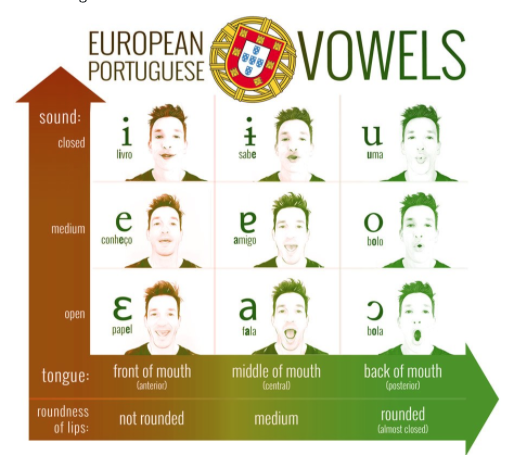
Pronunciation Guide for European Portuguese Vowels
August 17, 2020
It’s time to take a deep dive into the pronunciation of vowels in European Portuguese! First we’ll invite you to play around with this interactive guide and then we’ll cover all the factors that go into creating the variety of subtle variations between each vowel sound. Pronunciation of Vowels in European Portuguese Explore the guide […]
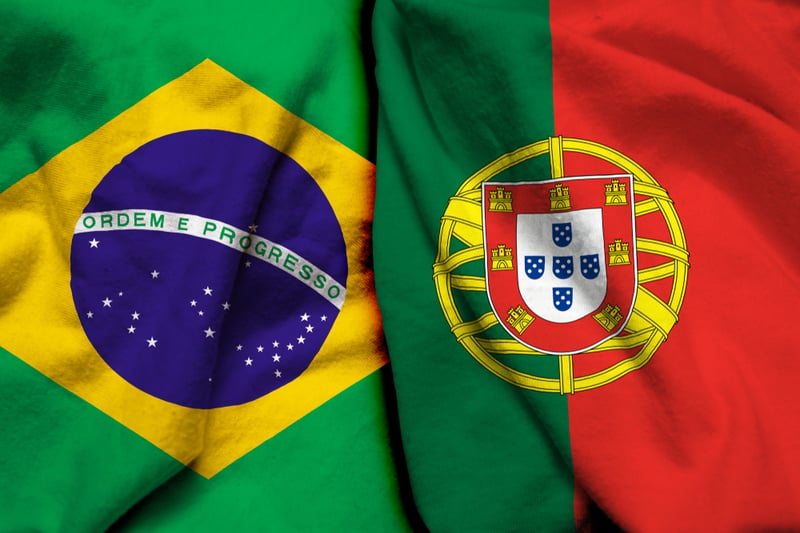
European vs Brazilian Portuguese
August 13, 2020
What’s the difference between European Portuguese vs Brazilian Portuguese? For starters, European Portuguese is the variant spoken in Portugal and is more similar to the dialects spoken in Africa and Asia. (It is sometimes called Continental Portuguese, or even Portuguese Portuguese! 😄 ) Given the size and population of Brazil, however, the Brazilian Portuguese set […]
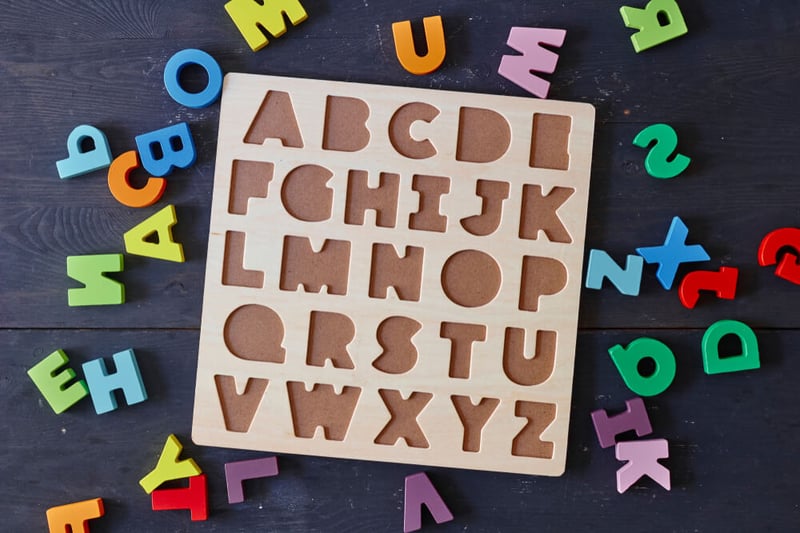
The European Portuguese Alphabet
August 13, 2020
This Learning Note will teach you how to spell using the letters of the European Portuguese alphabet, which will likely come in handy if you ever travel or move to Portugal. Receiving packages, making phone calls, and setting up services often require you to spell your name or other personal information, such as the name […]

Future Subjunctive
July 27, 2020
As previously mentioned, the allows us to talk about the conditions that must be met in order for a potential future action to occur, (i.e. “If this goes well, I will do that” or “When we get home, I will do that”). This tense appears in subordinate adverbial clauses (i.e. clauses which function like an […]

Imperfect Subjunctive
July 27, 2020
Another tense that makes up part of the conjuntivo is the . You learned about the pretérito imperfeito do indicativo, which references past events that were ongoing. In the conjuntivo, however, the imperfect refers to: past or future wishes and desires; something purely hypothetical in the past or future: i.e. imagining “what could have been” […]

Present Subjunctive
July 27, 2020
Presente do Conjuntivo As one of the tenses that makes up part of the conjuntivo (subjunctive) mood, the lets you talk about something that may or may not happen, but that is within the realm of possibility. This includes hopes, fears, doubts, and other hypotheticals. It tends to be paired with the presente do indicativo, […]

The Subjunctive Mood in Portuguese (Conjuntivo)
July 27, 2020
Conjuntivo: What is it? What in English is called the subjunctive mood, in European Portuguese is named . While the mood refers to actions that are certain or real, the conjuntivo, in contrast, indicates something possible, desired, hypothetical, or even unreal. It conveys the idea of uncertainty, doubt, or hope. It is often found in […]

Common Herbs & Spices in Portuguese Cuisine
June 24, 2020
Before we go any further, it’s best to explain the difference between and . Simply put, herbs are leaves while spices are seeds, bark, roots, and flowers. If you love food like we do, or want to understand the menu at a Portuguese restaurant, we think you’ll enjoy this guide to vocabulary for herbs and […]

Using Prepositions in Portuguese Questions
June 24, 2020
We’ll cover prepositions in more detail in later units, but for now, let’s go over a few prepositional phrases that come up frequently within Portuguese questions. You’ll notice that the preposition always comes right before the question word: Para Por

Using “é que” in European Portuguese Questions
June 24, 2020
You may have come across é que in a variety of Portuguese questions and wondered why these extra words are added. Technically, it’s optional — the core meaning stays the same with or without it. But in practice, including é que in open-ended European Portuguese questions is so common that you should typically default to […]
Translator
Hide
0/255