1
00:00:00,000 –> 00:00:02,610
PracticePortuguese.com
2
00:00:02,610 –> 00:00:07,450
Os termos “terras lusitanas” e “povo lusitano” são,
{{The terms “Lusitanian lands” and “Lusitanian people” are,}}
3
00:00:07,450 –> 00:00:09,190
com alguma frequência,
{{rather frequently,}}
4
00:00:09,190 –> 00:00:13,300
usados como referência a Portugal e aos seus habitantes.
{{used as a reference to Portugal and its inhabitants.}}
5
00:00:13,300 –> 00:00:15,810
Este termo foi cunhado pelos romanos,
{{This term was coined by the Romans,}}
6
00:00:15,810 –> 00:00:18,620
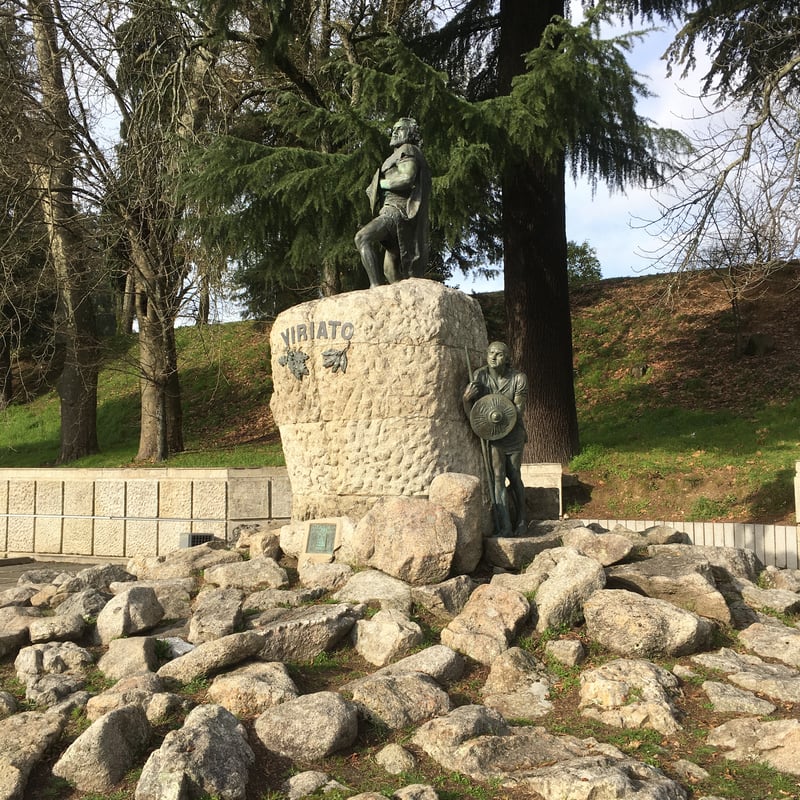
que acabaram por conquistar toda a península.
{{who eventually conquered the entire peninsula.}}
7
00:00:18,620 –> 00:00:19,980
Mas quem foram, então,
{{But who, then, were}}
8
00:00:19,980 –> 00:00:21,690
os lusitanos?
{{the Lusitanians?}}
9
00:00:21,690 –> 00:00:27,400
Os lusitanos foram um povo com influências célticas que se estabeleceu na Península Ibérica,
{{The Lusitanians were a people with Celtic influences who settled in the Iberian Peninsula,}}
10
00:00:27,400 –> 00:00:29,630
entre os rios Douro e Tejo,
{{between the Douro and Tagus rivers,}}
11
00:00:29,630 –> 00:00:32,630
durante o século VI a.C..
{{during the 6th century BC.}}
12
00:00:32,630 –> 00:00:37,960
O seu território incluía também partes da atual Estremadura espanhola.
{{Their territory also included parts of present-day Spanish Estremadura.}}
13
00:00:37,960 –> 00:00:40,380
À semelhança de outros povos vizinhos,
{{Like other neighbouring peoples,}}
14
00:00:40,380 –> 00:00:42,080
os lusitanos eram, na verdade,
{{the Lusitanians were, in fact,}}
15
00:00:42,080 –> 00:00:47,890
um grupo de várias tribos que partilhavam entre si a mesma cultura e costumes,
{{a group of several tribes who shared among themselves the same culture and customs,}}
16
00:00:47,890 –> 00:00:50,830
tribos essas governadas por clãs.
{{tribes ruled by clans.}}
17
00:00:50,830 –> 00:00:58,010
Viviam em aldeias fortificadas — os chamados ‘castros’ — e os seus edifícios eram circulares.
{{They lived in fortified villages – the so-called “castros” – and their buildings were circular.}}
18
00:00:58,010 –> 00:01:02,650
Eram um povo politeísta que praticava sacrifícios animais.
{{They were a polytheistic people who practiced animal sacrifices.}}
19
00:01:02,650 –> 00:01:08,720
Mercenários lusitanos combateram os Romanos sob o comando do general cartaginês Aníbal,
{{Lusitanian mercenaries fought the Romans under the command of the Carthaginian general Hannibal,}}
20
00:01:08,720 –> 00:01:13,320
e, mais tarde, entre os anos 153 e 139 a.C.
{{and, later, between 153 and 139 B.C.,}}
21
00:01:13,320 –> 00:01:16,320
liderados pelo famoso herói Viriato,
{{led by the famous hero Viriato,}}
22
00:01:16,320 –> 00:01:20,020
fizeram frente às tropas romanas na Península Ibérica.
{{they faced the Roman troops in the Iberian Peninsula.}}
23
00:01:20,020 –> 00:01:24,280
Este general lusitano terá ganho diversas batalhas até à sua morte,
{{This Lusitanian general is said to have won several battles until his death,}}
24
00:01:24,280 –> 00:01:27,890
quando foi traído por três dos seus próprios soldados.
{{when he was betrayed by three of his own soldiers.}}
25
00:01:27,890 –> 00:01:32,050
Os lusitanos terão passado a praticar uma longa guerra de guerrilha,
{{The Lusitanians are said to have engaged in a long guerrilla war,}}
26
00:01:32,050 –> 00:01:35,620
sem nunca conseguir expulsar os romanos da região.
{{never managing to expel the Romans from the region.}}
27
00:01:35,620 –> 00:01:47,820
Ainda assim, foi apenas no reino de Augusto — o primeiro imperador romano — que o território lusitano terá sido pacificado e oficialmente integrado no império.
{{Yet, it was only in the reign of Augustus – the first Roman emperor – that the Lusitanian territory was pacified and officially integrated into the empire.}}
28
00:01:47,820 –> 00:01:49,938
PracticePortuguese.com
Comments
Why is it that the verb ter also translates into is said?
Olá! And good question. In the sentence from the Shorty, the relevant part is “terá ganho várias batalhas até à sua morte”. The structure ter + past participle is being used with a future tense form (terá) to express something like “apparently” or “presumably” in the past. In historical or report-style narration, this “future of probability” often gets translated in English with expressions like “is said to have…”, “is believed to have…”, or “reportedly…”, rather than a very literal future tense. So in this context, the meaning is not “The Lusitanian general will have won…”, but rather “The Lusitanian general is said to have won… / supposedly won…”, reflecting that it is based on reports, tradition or uncertain historical sources.