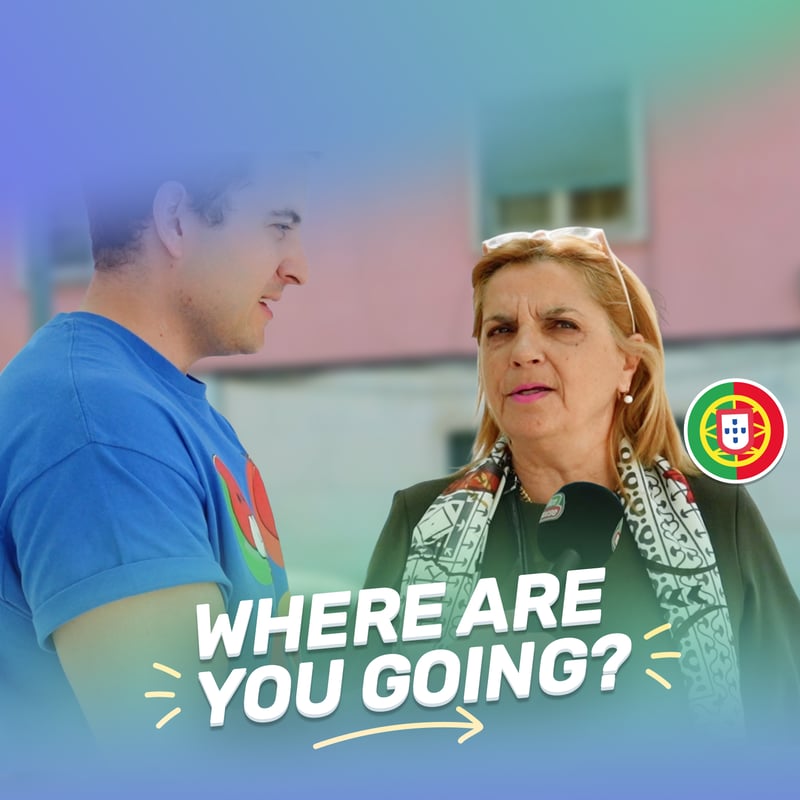
1
00:00:00,000 –> 00:00:02,710
Joel: Os portugueses são simpáticos, duma maneira geral?
{{Joel: Are Portuguese people friendly, in general?}}
2
00:00:02,710 –> 00:00:04,190
Entrevistada: Quer a peça para ser direta, não é?
{{Interviewee: You want the piece to be direct, right?}}
3
00:00:04,190 –> 00:00:04,710
Joel: Sim, por favor!
{{Joel: Yes, please!}}
4
00:00:04,710 –> 00:00:08,560
Os portugueses são simpáticos?
{{Are the Portuguese friendly?}}
5
00:00:08,560 –> 00:00:12,280
Entrevistada: Depende da cidade.
{{Interviewee: It depends on the city.}}
6
00:00:18,280 –> 00:00:23,390
Joel: Olá, bom dia. A senhora é portuguesa? Podemos fazer-lhe umas perguntas?
{{Joel: Hello, good morning. Are you Portuguese? Can we ask you a few questions?}}
7
00:00:23,390 –> 00:00:23,870
Entrevistada: É rápido?
{{Interviewee: Is it quick?}}
8
00:00:23,870 –> 00:00:25,750
Joel: É, é rápido. Quanto tempo tem?
{{Joel: Yes, it’s quick. How much time do you have?}}
9
00:00:25,750 –> 00:00:27,340
Entrevistada: Para aí uns cinco… Até a minha colega chegar.
{{Interviewee: About 5… Until my colleague arrives.}}
10
00:00:27,340 –> 00:00:28,890
Joel: Está bom, então vou tentar ser rápido.
{{Joel: Okay, then I’ll try to be quick.}}
11
00:00:28,890 –> 00:00:34,290
A senhora acha que os portugueses, duma maneira geral, são simpáticos?
{{Do you think that the Portuguese, in general, are friendly?}}
12
00:00:34,290 –> 00:00:35,310
Entrevistada: Acho que sim.
{{Interviewee: I think so.}}
13
00:00:35,310 –> 00:00:36,050
Joel: Sim?
{{Joel: Yes?}}
14
00:00:36,050 –> 00:00:37,201
Entrevistada: Espero que sim.
{{Interviewee: I hope so.}}
15
00:00:37,201 –> 00:00:37,660
Sim.
{{Yes.}}
16
00:00:37,660 –> 00:00:39,290
Sim, acho que sim.
{{Yes, I think so.}}
17
00:00:39,290 –> 00:00:39,660
Acho que sim.
{{I think so.}}
18
00:00:39,660 –> 00:00:40,170
Sim.
{{Yes.}}
19
00:00:40,170 –> 00:00:41,470
Joel: Sim?
{{Joel: Yes?}}
20
00:00:41,470 –> 00:00:45,190
Entrevistada: Eu acho que sim, fazemos por isso. Eu acho que sim.
{{Interviewee: I think so, we try to be. I think so.}}
21
00:00:45,190 –> 00:00:47,240
De forma geral, acho que somos simpáticos.
{{In general, I think we’re friendly.}}
22
00:00:47,240 –> 00:00:51,040
Sim, sim, duma forma geral, eu diria que sim. Povo acolhedor.
{{Yes, yes, in general, I’d say so. Welcoming people.}}
23
00:00:51,040 –> 00:00:53,530
Sim, são simpáticos e acolhedores.
{{Yes, they’re friendly and welcoming.}}
24
00:00:53,530 –> 00:00:55,440
Rui: Queres perguntar à colega da senhora?
{{Rui: Do you want to ask the lady’s colleague?}}
25
00:00:55,440 –> 00:00:56,570
Entrevistada: Quer, quer. Anda cá.
{{Interviewee: He does, he does. Come here.}}
26
00:00:56,570 –> 00:01:00,830
Joel: A colega da senhora? Sim, sim, venha, venha!
{{Joel: The lady’s colleague? Yes, yes, come, come!}}
27
00:01:00,830 –> 00:01:02,380
É para os estrangeiros aprenderem português.
{{It’s for foreigners to learn Portuguese.}}
28
00:01:02,380 –> 00:01:05,590
E a senhora acha que os portugueses são simpáticos?
{{And do you think the Portuguese are friendly?}}
29
00:01:05,590 –> 00:01:06,740
Entrevistada: Muito. Eu acho que sim.
{{Interviewee: Very. I think so.}}
30
00:01:06,740 –> 00:01:07,620
Joel: Sim, eu também acho.
{{Joel: Yes, I think so too.}}
31
00:01:07,620 –> 00:01:09,350
Entrevistada: Não tem essa opinião?
{{Interviewee: You don’t have that opinion?}}
32
00:01:09,350 –> 00:01:10,500
Joel: Eu tenho, sim.
{{Joel: I do, yes.}}
33
00:01:10,500 –> 00:01:11,460
Entrevistada: Tem, tem? OK.
{{Interviewee: You do, you do? OK.}}
34
00:01:11,460 –> 00:01:14,440
Joel: Mas acham que os portugueses são simpáticos, duma maneira geral?
{{Joel: But do you think the Portuguese are friendly, in general?}}
35
00:01:14,440 –> 00:01:16,120
Entrevistada: Ai, são, até para os turistas.
{{Interviewee: Oh, they are, even to tourists.}}
36
00:01:16,120 –> 00:01:18,670
Sim, sim, em geral, são bastante simpáticos.
{{Yes, yes, in general, they’re quite friendly.}}
37
00:01:18,670 –> 00:01:21,500
Joel: Os portugueses são simpáticos, duma maneira geral?
{{Joel: Are the Portuguese friendly, in general?}}
38
00:01:21,500 –> 00:01:22,040
Entrevistada: Não.
{{Interviewee: No.}}
39
00:01:22,040 –> 00:01:22,620
Joel: Não?
{{Joel: No?}}
40
00:01:22,620 –> 00:01:23,090
Entrevistada: Não.
{{Interviewee: No.}}
41
00:01:23,090 –> 00:01:24,180
Joel: Porquê?
{{Joel: Why?}}
42
00:01:24,180 –> 00:01:28,930
Entrevistada: Porque é cultural, sei lá. Porque nós, portugueses,
{{Interviewee: Because it’s cultural, I don’t know. Because we Portuguese,}}
43
00:01:28,930 –> 00:01:29,920
somos um bocado parvos com os estrangeiros, na verdade.
{{we’re a bit clueless with foreigners, really.}}
44
00:01:29,920 –> 00:01:33,130
Quer a peça para ser direta, não é?
{{You want the piece to be direct, don’t you?}}
45
00:01:33,130 –> 00:01:35,070
Joel: Sim, por favor! É melhor.
{{Joel: Yes, please! It’s better.}}
46
00:01:35,070 –> 00:01:36,460
Entrevistada: Sim, sim. Somos um bocado frios.
{{Interviewee: Yes, yes. We’re a bit cold.}}
47
00:01:36,460 –> 00:01:38,470
Joel: Os portugueses são simpáticos?
{{Joel: Are the Portuguese nice?}}
48
00:01:38,470 –> 00:01:44,130
Entrevistada: Depende. Há uns que são, há outros que não. É como todo o povo.
{{Interviewee: It depends. Some are, some aren’t. It’s like all people.}}
49
00:01:44,130 –> 00:01:44,650
Joel: Sim.
{{Joel: Yes.}}
50
00:01:44,650 –> 00:01:48,170
Entrevistada: Seja português, seja estrangeiro. Depende de pessoa para pessoa.
{{Interviewee: Whether they’re Portuguese or foreigners. It depends from person to person.}}
51
00:01:48,170 –> 00:01:49,200
Joel: Posso tratar-te por tu?
{{Joel: Can I treat you as “tu” (informal form of you)?}}
52
00:01:49,200 –> 00:01:49,660
Entrevistado: Sim, sim.
{{Interviewee: Yes, yes.}}
53
00:01:49,660 –> 00:01:52,610
Joel: Achas que, duma maneira geral, os portugueses são simpáticos?
{{Joel: Do you think that, in general, the Portuguese are friendly?}}
54
00:01:52,610 –> 00:01:53,610
Entrevistado: Acho que sim.
{{Interviewee: I think so.}}
55
00:01:53,610 –> 00:01:55,440
Joel: Sim? És de Lisboa? És de cá?
{{Joel: Yes? Are you from Lisbon? Are you from here?}}
56
00:01:55,440 –> 00:01:56,150
Entrevistado: Sou de Lisboa, sim.
{{Interviewee: I’m from Lisbon, yes.}}
57
00:01:56,150 –> 00:01:58,160
Joel: OK, boa. Eu também acho que são simpáticos.
{{Joel: Okay, good. I think they’re friendly too.}}
58
00:01:58,160 –> 00:02:02,340
Às vezes, no início, são um pouco tímidos, especialmente com os estrangeiros,
{{Sometimes, at first, they’re a bit shy, especially with foreigners,}}
59
00:02:02,340 –> 00:02:07,460
mas depois começam a [abrir-se] mais e acabam por ser muito…
{{but then they start to open up more and end up being very…}}
60
00:02:07,460 –> 00:02:08,560
Como se diz? Acolhedores.
{{How do you say? Welcoming.}}
61
00:02:08,560 –> 00:02:10,250
Vocês são de onde?
{{Where are you from?}}
62
00:02:10,250 –> 00:02:11,650
Entrevistada: Somos cabo-verdianos.
{{Interviewee: We’re Cape Verdean.}}
63
00:02:11,650 –> 00:02:14,940
Joel: Os portugueses, de uma maneira geral, são simpáticos?
{{Joel: The Portuguese, in general, are they friendly?}}
64
00:02:14,940 –> 00:02:15,850
Entrevistada: Sim, sim, são.
{{Interviewee: Yes, yes, they are.}}
65
00:02:15,850 –> 00:02:18,130
Joel: É de onde?
{{Joel: Where are you from?}}
66
00:02:18,130 –> 00:02:18,710
Entrevistada: Angola.
{{Interviewee: Angola.}}
67
00:02:18,710 –> 00:02:22,260
Joel: Os portugueses são simpáticos ou menos simpáticos? Pode ser sincera.
{{Joel: Are the Portuguese friendly or less friendly? You can be honest.}}
68
00:02:22,260 –> 00:02:24,350
Entrevistada: Menos simpáticos.
{{Interviewee: Less friendly.}}
69
00:02:24,350 –> 00:02:26,360
Sim, menos simpáticos.
{{Yes, less friendly.}}
70
00:02:26,360 –> 00:02:28,910
Joel: E consegue pensar numa situação em que reparou nisso?
{{Joel: And can you think of a situation in which you’ve noticed that?}}
71
00:02:28,910 –> 00:02:33,030
Entrevistada: Em várias. Muitas, sim, às vezes…
{{Interviewee: Several. Many, yes, sometimes…}}
72
00:02:33,030 –> 00:02:36,580
É assim, para pedir uma informação ou às vezes…
{{It’s like this, to ask for information or sometimes…}}
73
00:02:36,580 –> 00:02:38,590
Eles são mais reservados, eu digo isso.
{{They’re more reserved, I’ll say that.}}
74
00:02:38,590 –> 00:02:39,240
Joel: Mais tímidos.
{{Joel: More shy.}}
75
00:02:39,240 –> 00:02:43,580
Entrevistada: Mais tímidos, mais na deles. Então, angolano é muito mais acolhedor.
{{Interviewee: More shy, more in their own way. So Angolans are much more welcoming.}}
76
00:02:43,580 –> 00:02:45,520
Um bocadinho semelhante ao brasileiro.
{{A little bit like Brazilians.}}
77
00:02:45,520 –> 00:02:51,440
É mais de acolher as pessoas e de mostrar mais cara feliz.
{{It’s more about welcoming people and showing a happy face.}}
78
00:02:51,440 –> 00:02:52,690
Joel: Mais à vontade, não é?
{{Joel: More at ease, right?}}
79
00:02:52,690 –> 00:02:58,320
Qual acha que é a nacionalidade mais simpática no mundo?
{{What do you think is the friendliest nationality in the world?}}
80
00:02:58,320 –> 00:02:58,840
Entrevistada: É a portuguesa.
{{Interviewee: It’s the Portuguese.}}
81
00:02:58,840 –> 00:03:00,410
Joel: Portuguesa, muito bem!
{{Joel: Portuguese, very well!}}
82
00:03:00,410 –> 00:03:03,580
De onde vêm as pessoas mais simpáticas em Portugal?
{{Where do the friendliest people in Portugal come from?}}
83
00:03:03,580 –> 00:03:08,340
Entrevistado: Eu penso que seja duma geração mais antiga, os mais…
{{Interviewee: I think it’s from an older generation, the most…}}
84
00:03:08,340 –> 00:03:15,760
Ou seja, da década de 40, 50, por aí, são a geração de 70 de agora, 80.
{{That is, from the 40s, 50s, around there, it’s the generation that’s now 70 or 80.}}
85
00:03:15,760 –> 00:03:17,920
Acho que são as pessoas mais simpáticas.
{{I think they’re the friendliest people.}}
86
00:03:17,920 –> 00:03:21,620
Joel: OK, então acha que as pessoas mais jovens são mais desconfiadas?
{{Joel: OK, so you think younger people are more suspicious?}}
87
00:03:21,620 –> 00:03:24,230
Entrevistado: Sim, sim, acho, acho.
{{Interviewee: Yes, yes, I think (so), I think (so).}}
88
00:03:24,230 –> 00:03:26,570
Joel: Os portugueses são simpáticos?
{{Joel: Are the Portuguese friendly?}}
89
00:03:26,570 –> 00:03:28,300
Entrevistada: Depende da cidade.
{{Interviewee: It depends on the city.}}
90
00:03:28,300 –> 00:03:32,440
Eu sei que no Porto, donde eu sou, as pessoas são muito calorosas.
{{I know that in Porto, where I’m from, people are very warm.}}
91
00:03:32,440 –> 00:03:34,560
Aqui, como é uma capital, é capaz de ser um pouco mais…
{{Here, as it’s a capital, it might be a bit more…}}
92
00:03:34,560 –> 00:03:37,000
As pessoas são um pouco mais frias.
{{People are a bit colder.}}
93
00:03:37,000 –> 00:03:39,650
No Norte, são mais simpáticos, se calhar, do que em Lisboa.
{{In the North, they’re probably nicer than in Lisbon.}}
94
00:03:39,650 –> 00:03:43,650
Joel: Sim, uma outra senhora disse que o Porto tem pessoas simpáticas lá.
{{Joel: Yes, another lady said that Porto has nice people there.}}
95
00:03:43,650 –> 00:03:46,100
E no Porto, diz-se mais asneiras, não é?
{{And in Porto, people swear more, don’t they?}}
96
00:03:46,100 –> 00:03:48,340
Entrevistada: Sim, mas é uma asneira calorosa também.
{{Interviewee: Yes, but it’s warm swearing too. (It’s done in a friendly way)}}
97
00:03:48,340 –> 00:03:50,250
Joel: Sim, não é para ofender, é só para…
{{Joel: Yes, it’s not to offend, it’s just to…}}
98
00:03:50,250 –> 00:03:50,390
Entrevistada: Não tem intenção…
{{Interviewee: It’s not intended…}}
99
00:03:50,390 –> 00:03:53,710
É só porque somos mais soltos a falar, então dizemos o que nos apetece.
{{It’s just that we’re looser with our words, so we say what we feel like.}}
100
00:03:53,710 –> 00:03:57,610
Joel: Alguém disse-nos que as pessoas do Porto eram mais simpáticas, achei interessante.
{{Joel: Someone told us that people from Porto were friendlier, I thought that was interesting.}}
101
00:03:57,610 –> 00:04:00,770
Entrevistado: Existe essa cultura de… De existir…
{{Interviewee: There’s this culture of… Of there being…}}
102
00:04:00,770 –> 00:04:03,980
As pessoas do Norte, é considerado as pessoas mais simpáticas.
{{People from the North are considered to be the friendliest people.}}
103
00:04:03,980 –> 00:04:07,360
Joel: Existe alguma zona mais simpática que outras?
{{Joel: Is there any area that’s friendlier than others?}}
104
00:04:07,360 –> 00:04:09,680
Entrevistada: Mais Centro para Sul.
{{Interviewee: More Central to the South.}}
105
00:04:09,680 –> 00:04:10,690
Joel: OK.
{{Joel: OK.}}
106
00:04:10,690 –> 00:04:12,920
Entrevistada: Eu acho que é ao contrário, acho que é mais Centro para Norte.
{{Interviewee: I think it’s the other way around, I think it’s more Central to the North.}}
107
00:04:12,920 –> 00:04:13,620
Joel: Para o Norte?
{{Joel: To the North?}}
108
00:04:13,620 –> 00:04:17,050
Entrevistada: Eu tive uma vez de férias no Gerês e eu achei as pessoas muito simpáticas lá
{{Interviewee: I had a vacation in Gerês once and I found the people there very friendly}}
109
00:04:17,050 –> 00:04:21,370
e muito prestativas e gostavam de ajudar.
{{and very helpful and they liked to help.}}
110
00:04:21,370 –> 00:04:23,800
Até mesmo as pessoas que estavam de férias, estavam sempre dispostas [a] ajudar.
{{Even the people who were on vacation were always willing to help.}}
111
00:04:23,800 –> 00:04:26,220
Joel: É de que zona, originalmente?
{{Joel: What area are you from originally?}}
112
00:04:26,220 –> 00:04:29,660
Entrevistada: Sou… Eu nasci em Lisboa, com vivência no Minho.
{{Interviewee: I’m… I was born in Lisbon, with experience in Minho. (also spent time living in Minho)}}
113
00:04:29,660 –> 00:04:29,980
Joel: Onde?
{{Joel: Where?}}
114
00:04:29,980 –> 00:04:31,120
Entrevistada: No Minho.
{{Interviewee: In Minho.}}
115
00:04:31,120 –> 00:04:31,530
Joel: Minho?
{{Joel: Minho?}}
116
00:04:31,530 –> 00:04:32,140
Entrevistada: Minho, Braga.
{{Interviewee: Minho, Braga.}}
117
00:04:32,140 –> 00:04:33,390
Joel: É uma zona no Norte?
{{Joel: Is it an area in the North?}}
118
00:04:33,390 –> 00:04:36,530
Entrevistada: É uma zona em Braga, é… no Norte de Portugal.
{{Interviewee: It’s an area in Braga, it’s… in the North of Portugal.}}
119
00:04:36,530 –> 00:04:39,960
Depois, a minha vida profissional levou-me até às Beiras,
{{Then my professional life took me to the Beiras,}}
120
00:04:39,960 –> 00:04:42,540
tenho uns anos de Covilhã e agora outra vez Lisboa.
{{I spent a few years in Covilhã and now Lisbon again.}}
121
00:04:42,540 –> 00:04:45,500
Joel: E as pessoas são mais simpáticas lá ou aqui?
{{Joel: And are people nicer there or here?}}
122
00:04:45,500 –> 00:04:50,330
Entrevistada: As pessoas são mais verdadeiras, são mais transparentes no Minho.
{{Interviewee: People are more truthful, more transparent in Minho.}}
123
00:04:50,330 –> 00:04:52,370
Mas acho que geralmente… Não sei.
{{But I think that generally… I don’t know.}}
124
00:04:52,370 –> 00:04:56,640
Se calhar, quem é estrangeiro dirá melhor.
{{Maybe people from abroad will tell you better.}}
125
00:04:56,640 –> 00:04:58,300
Vocês são de que rádios?
{{Which radio station are you from?}}
126
00:04:58,300 –> 00:04:59,240
Ele é canadiano.
{{He’s Canadian.}}
127
00:04:59,240 –> 00:05:00,430
Joel: Eu sou do Canadá, sim.
{{Joel: I’m from Canada, yes.}}
128
00:05:00,430 –> 00:05:00,490
Entrevistada: Ai é?
{{Interviewee: Is that so?}}
129
00:05:00,490 –> 00:05:02,250
Entrevistada: Ele é do Canadá.
{{Interviewee: He’s from Canada.}}
130
00:05:02,250 –> 00:05:03,520
Olha, um sítio que eu gostava.
{{Look, a place I would like [to visit].}}
131
00:05:03,520 –> 00:05:04,400
Entrevistada: Eu também.
{{Interviewee: Me too.}}
132
00:05:04,400 –> 00:05:06,030
Joel: E a Joana é do Alentejo.
{{Joel: And Joana is from Alentejo.}}
133
00:05:06,030 –> 00:05:07,500
Entrevistada: Ela é de onde?
{{Interviewee: Where is she from?}}
134
00:05:07,500 –> 00:05:08,420
Joana: Portalegre.
{{Joana: Portalegre.}}
135
00:05:08,420 –> 00:05:11,410
Joel: E qual é a região mais simpática em Portugal?
{{Joel: And what’s the friendliest region in Portugal?}}
136
00:05:11,410 –> 00:05:12,980
Entrevistado: O Alentejo.
{{Interviewee: The Alentejo.}}
137
00:05:12,980 –> 00:05:12,990
Joel: Alentejo?
{{Joel: Alentejo?}}
138
00:05:12,990 –> 00:05:13,870
Entrevistado: O Alentejo e o Norte.
{{Interviewee: The Alentejo and the North.}}
139
00:05:13,870 –> 00:05:15,980
Joel: Ela é do Alentejo.
{{Joel: She’s from the Alentejo.}}
140
00:05:15,980 –> 00:05:18,780
Entrevistada: Os alentejanos não são nada mandriões como dizem.
{{Interviewee: Alentejans aren’t as lazy as they say.}}
141
00:05:18,780 –> 00:05:19,700
Joana: Não é?
{{Joana: Aren’t they?}}
142
00:05:19,700 –> 00:05:21,620
Joel: São trabalhadores, não é?
{{Joel: They’re hardworking, aren’t they?}}
143
00:05:21,620 –> 00:05:23,590
Entrevistado: Eu acho que mais… Não sei.
{{Interviewee: I think more… I don’t know.}}
144
00:05:23,590 –> 00:05:25,760
Mais para o interior, acho que são mais simpáticos.
{{More inland, I think they’re nicer.}}
145
00:05:25,760 –> 00:05:26,700
Joel: No Norte, nas aldeias?
{{Joel: In the North, in the villages?}}
146
00:05:26,700 –> 00:05:26,700
Entrevistada: Aceito.
{{Interviewee: I accept.}}
147
00:05:26,700 –> 00:05:29,530
Na minha experiência, é claro, não sei.
{{In my experience, of course, I don’t know.}}
148
00:05:29,530 –> 00:05:30,650
Joel: E tu és de Lisboa?
{{Joel: And you’re from Lisbon?}}
149
00:05:30,650 –> 00:05:32,140
Entrevistado: Não, eu sou da zona centro.
{{Interviewee: No, I’m from the center.}}
150
00:05:32,140 –> 00:05:36,410
Sou do Ribatejo, portanto… Zona do Entroncamento, Tomar, por aí.
{{I’m from Ribatejo, so… Entroncamento, Tomar, around there.}}
151
00:05:36,410 –> 00:05:40,650
Joel: OK. E repara [em] alguma diferença entre as pessoas de lá e as pessoas de Lisboa?
{{Joel: OK. And do you notice any difference between the people there and the people in Lisbon?}}
152
00:05:40,650 –> 00:05:43,150
Entrevistado: Sim, as pessoas de lá também são um bocadinho mais simpáticas
{{Interviewee: Yes, the people there are also a bit friendlier}}
153
00:05:43,150 –> 00:05:44,190
que as pessoas de Lisboa.
{{than the people in Lisbon.}}
154
00:05:44,190 –> 00:05:48,600
Joel: As pessoas das aldeias mais pequenas não estão com tanta pressa
{{Joel: The people in the smaller villages aren’t in such a hurry}}
155
00:05:48,600 –> 00:05:50,120
como aqui em Lisboa.
{{as they are here in Lisbon.}}
156
00:05:50,120 –> 00:05:56,000
Entrevistada: Sim, acho que realmente… E também têm uma necessidade de comunicação.
{{Interviewee: Yes, I think that really… And they also have a need to communicate.}}
157
00:05:56,000 –> 00:05:59,010
Gostam de falar com outras pessoas, porque são ambientes fechados,
{{They like to talk to other people, because it’s a closed environment,}}
158
00:05:59,010 –> 00:06:04,640
não têm tanta gente e por isso têm necessidade de quem vem de fora…
{{there aren’t so many people and so they need people from outside…}}
159
00:06:04,640 –> 00:06:06,680
Poderem ter o diálogo.
{{They can have a dialogue.}}
160
00:06:06,680 –> 00:06:07,410
Joel: É lisboeta?
{{Joel: Are you from Lisbon?}}
161
00:06:07,410 –> 00:06:10,020
Entrevistada: Nasci em África, mas vivo cá há muitos anos.
{{Interviewee: I was born in Africa, but I’ve lived here for many years.}}
162
00:06:10,020 –> 00:06:11,600
Joel: Ah, OK, muito bem.
{{Joel: Ah, OK, very good.}}
163
00:06:11,600 –> 00:06:15,880
Entrevistado: Acho que aqui é muito ritmo, é muito rápido tudo.
{{Interviewee: I think it’s very fast-paced here (it’s a lot of rhythm), everything’s very fast.}}
164
00:06:15,880 –> 00:06:17,890
Portanto, as pessoas não têm tempo para ser tão simpáticas.
{{Therefore, people don’t have time to be so friendly.}}
165
00:06:17,890 –> 00:06:20,800
Joel: Acho que é assim em qualquer capital, não é? A vida é mais rápida.
{{Joel: I think it’s like that in any capital, isn’t it? Life is faster.}}
166
00:06:20,800 –> 00:06:21,700
Entrevistado: Sim, sim.
{{Interviewee: Yes, yes.}}
167
00:06:21,700 –> 00:06:23,090
Joel: É lisboeta?
{{Joel: Are you from Lisbon?}}
168
00:06:23,090 –> 00:06:24,730
Entrevistada: Sim.
{{Interviewee: Yes.}}
169
00:06:24,730 –> 00:06:28,760
Joel: OK. Eu ouvi dizer que as pessoas em Lisboa têm menos paciência
{{Joel: OK. I’ve heard that people in Lisbon have less patience}}
170
00:06:28,760 –> 00:06:31,330
do que as pessoas no interior, por exemplo.
{{than people in the countryside, for example.}}
171
00:06:31,330 –> 00:06:33,280
Entrevistada: Eu acho que é por ser uma cidade maior.
{{Interviewee: I think it’s because it’s a bigger city.}}
172
00:06:33,280 –> 00:06:37,150
Aliás, por estarmos na capital, as pessoas veem-se menos.
{{Moreover, because we’re in the capital, people see less of each other.}}
173
00:06:37,150 –> 00:06:40,410
Eu vivo na Margem Sul. A verdade é que eu nasci em Lisboa, portanto…
{{I live on the South Bank. The truth is that I was born in Lisbon, so…}}
174
00:06:40,410 –> 00:06:44,020
Nós na Margem Sul, basta passarmos o rio, as coisas são diferentes.
{{We on the South Bank, you just have to cross the river, things are different.}}
175
00:06:44,020 –> 00:06:48,440
As pessoas… Falamos aos vizinhos, se vemos um vizinho entrar com compras,
{{People… We talk to the neighbours, if we see a neighbour coming in with shopping,}}
176
00:06:48,440 –> 00:06:50,500
nós abrimos a porta, mas isso não acontece aqui em Lisboa.
{{we open the door, but that doesn’t happen here in Lisbon.}}
177
00:06:50,500 –> 00:06:53,320
Já vivi aqui em Lisboa e eu dizia bom dia aos meus vizinhos
{{I’ve lived here in Lisbon and I’d say good morning to my neighbours}}
178
00:06:53,320 –> 00:06:55,620
e os meus vizinhos não me respondiam, OK? Portanto, sim…
{{and my neighbours wouldn’t answer me, OK? So, yes…}}
179
00:06:55,620 –> 00:06:57,240
Joel: São mais desconfiados, não é?
{{Joel: They’re more mistrustful, aren’t they?}}
180
00:06:57,240 –> 00:07:00,480
Entrevistada: Epá, não sei se será essa a palavra. Mas sim.
{{Interviewee: Oh, I don’t know if that’s the word. But yes.}}
181
00:07:00,480 –> 00:07:07,100
Joel: Eu também reparei. Eu sou do Canadá e lá pode-se dizer ‘good morning’
{{Joel: I’ve noticed it too. I’m from Canada and there you can say ‘good morning’}}
182
00:07:07,100 –> 00:07:08,480
a qualquer pessoa, bom dia.
{{to anyone, good morning.}}
183
00:07:08,480 –> 00:07:08,830
Entrevistada: Exato, sim.
{{Interviewee: Exactly, yes.}}
184
00:07:08,830 –> 00:07:11,910
Joel: E a pessoa responde duma forma simpática, mas aqui, às vezes,
{{Joel: And the person responds in a friendly way, but here, sometimes,}}
185
00:07:11,910 –> 00:07:14,180
as pessoas estão, tipo, “Eu conheço-te de algum lado?” Ou…
{{people are, like, “Do I know you from somewhere?” Or…}}
186
00:07:14,180 –> 00:07:15,600
Entrevistada: Exato, exato.
{{Interviewee: Exactly, exactly.}}
187
00:07:15,600 –> 00:07:19,010
Há aqueles que você dá um bom dia e são simpáticos
{{There are those you say good morning to and they’re friendly}}
188
00:07:19,010 –> 00:07:21,700
e há aqueles que dá um bom dia e que lhe mandam dar uma curva.
{{and there are those you say good morning to and they tell you to get lost. (take a turn)}}
189
00:07:21,700 –> 00:07:23,160
Joel: Viram a cabeça, pelo menos.
{{Joel: They turn their heads, at least.}}
190
00:07:23,160 –> 00:07:24,430
Entrevistada: Nem sequer falam consigo.
{{Interviewee: They don’t even talk to you.}}
191
00:07:24,430 –> 00:07:26,350
Joel: E é de onde, originalmente?
{{Joel: And where are you from, originally?}}
192
00:07:26,350 –> 00:07:27,140
Entrevistada: Sou de Lisboa.
{{Interviewee: I’m from Lisbon.}}
193
00:07:27,140 –> 00:07:28,170
Joel: Ah, OK, muito bem.
{{Joel: Ah, OK, very good.}}
194
00:07:28,170 –> 00:07:30,560
Entrevistada: Eu chego à paragem e digo bom dia a toda a gente.
{{Interviewee: I get to the stop and say good morning to everyone.}}
195
00:07:30,560 –> 00:07:33,330
Claro, nem toda a gente me responde, mas a grande maioria responde.
{{Of course, not everyone answers me, but the vast majority do.}}
196
00:07:33,330 –> 00:07:36,220
Se eu fizer isto aqui em Lisboa, as pessoas vão achar que eu sou doida, OK?
{{If I do this here in Lisbon, people will think I’m crazy, OK?}}
197
00:07:36,220 –> 00:07:42,050
Joel: E qual região de Portugal tem as pessoas mais simpáticas? Tem noção?
{{Joel: And which region of Portugal has the friendliest people? Do you have any idea?}}
198
00:07:42,050 –> 00:07:44,550
Entrevistada: Sim, existem pessoas simpáticas em todo o lado.
{{Interviewee: Yes, there are friendly people everywhere.}}
199
00:07:44,550 –> 00:07:47,020
Acho… Regra geral, acho que é o país inteiro.
{{I think… As a general rule, I think it’s the whole country.}}
200
00:07:47,020 –> 00:07:54,500
Sim, há pessoas simpáticas em todo o lado e antipáticas também, não é?
{{Yes, there are friendly people everywhere and unfriendly ones too, aren’t there?}}
Os Portugueses São Simpáticos?
Are Portuguese People Friendly?
Download episode
Please request our permission before redistributing these files.
With a Premium Subscription, you can also download PDF transcriptions, with or without English translations for printing or offline use.
- 00:00:000Joel: Os portugueses são simpáticos, duma maneira geral? Joel: Are Portuguese people friendly, in general?
- 00:00:022.71Entrevistada: Quer a peça para ser direta, não é? Interviewee: You want the piece to be direct, right?
- 00:00:044.19Joel: Sim, por favor! Joel: Yes, please!
- 00:00:044.71Os portugueses são simpáticos? Are the Portuguese friendly?
- 00:00:088.56Entrevistada: Depende da cidade. Interviewee: It depends on the city.
- 00:00:1818.28Joel: Olá, bom dia. A senhora é portuguesa? Podemos fazer-lhe umas perguntas? Joel: Hello, good morning. Are you Portuguese? Can we ask you a few questions?
- 00:00:2323.39Entrevistada: É rápido? Interviewee: Is it quick?
With a Premium Subscription, you can take episode quizzes to challenge your comprehension skills and track your progress!

With a Premium Subscription, you can save these phrases to Smart Review, and use spaced repetition to commit them to long-term memory.
Joana
Joel


Comments
I think it is very important to hear other people’s voices. Because it is necessary to get into this day-to-day talk that people have on the street.