 Eduardo
- PracticePortuguese.com
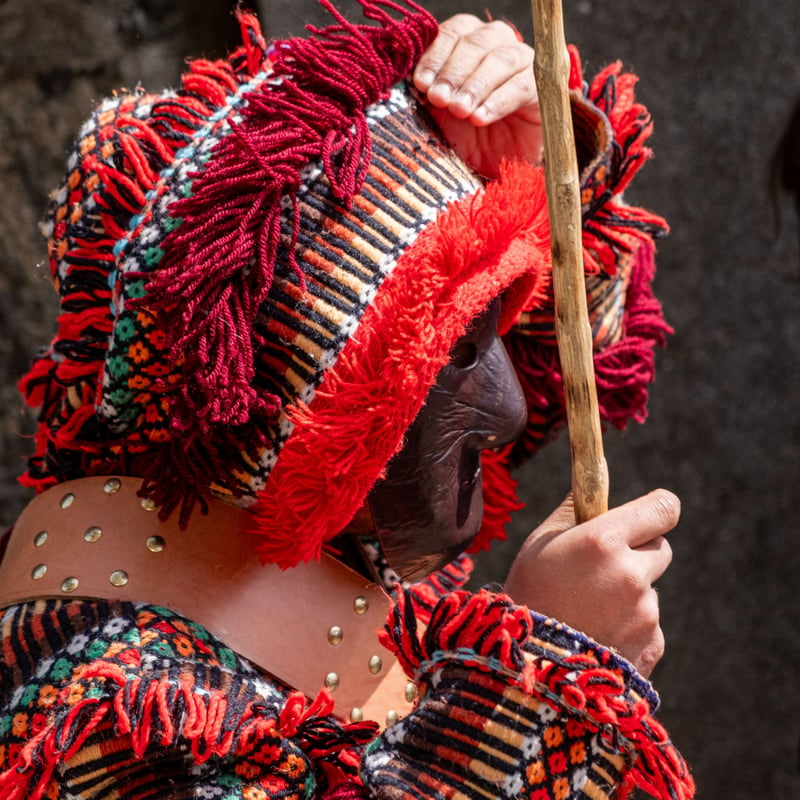
- Durante o Carnaval, na aldeia de Podence, During Carnival, in the village of Podence,
- é possível assistir a um ritual ancestral, colorido e, sobretudo, barulhento it is possible to witness an ancestral, colourful and, above all, noisy ritual
- chamado Entrudo Chocalheiro. called Entrudo Chocalheiro.
- Esta aldeia transmontana, no distrito de Bragança, This village in Trás-os-Montes, in the district of Bragança,
- torna-se um palco aberto para criaturas diabólicas becomes an open stage for diabolical creatures
- que percorrem alegremente as ruas who happily roam the streets
Premium Members get access to this episode's entire transcription, as well as hundreds more!
Vocabulary
capuzhood o casamentowedding, marriage chocalharto rattle o couroleather o desfileparade franjafringe, bangs a latacan, tin madeirawood a máscaramask outroraonce, formerly, occasionally o palcostage pontiagudopointed protagonizadostarring, played by, led sing.,masc. o trajecostume transmontanafrom Trás-os-Montes sing.,fem.


Expressions
apesar dealthough, despite, even though Hoje em diaNowadays, These days
Premium Feature: Smart Review
With a Premium Subscription, you can save these phrases to Smart Review, and use spaced repetition to commit them to long-term memory.
Premium Feature: Episode Quizzes
With a Premium Subscription, you can take episode quizzes to challenge your comprehension skills and track your progress!









Comments
Obrigada! Muito interessante e depois de ouvir este “Shortie”, encontrei tantos vídeos no YouTube (em PT-PT!) também sobre o festival em Podence que foram divertidos de ver.
Hello, I have a question about “ começando no Domingo Gordo e terminando na Terça-feira Gorda.” I thought in European Portuguese you don’t use verb + ando but you use a+verb to mean -ing. Or do you use both? In which cases do you use verb+ando?
Olá! Overall, we use both forms, but not always in the same contexts. For example, in the line you mentioned, both ‘-ando’ and ‘a+verb’ can be used interchangeably, although ‘-ando’ is the usual choice in more formal/literary texts such as this one. On the other hand, to form the present continuous, ‘estar + a + verb’ is a strong preference, at least within the dominant European Portuguese language pattern (as spoken in the Lisbon region and around). ‘Estar + -ando’ is also grammatically correct, but restricted to few regions, e.g. Alentejo.
We have a good Learning Note detailing the uses of the Portuguese gerund (-ando form): The Gerund | Practice Portuguese