 Eliana
 Pedro
Pedro Rui
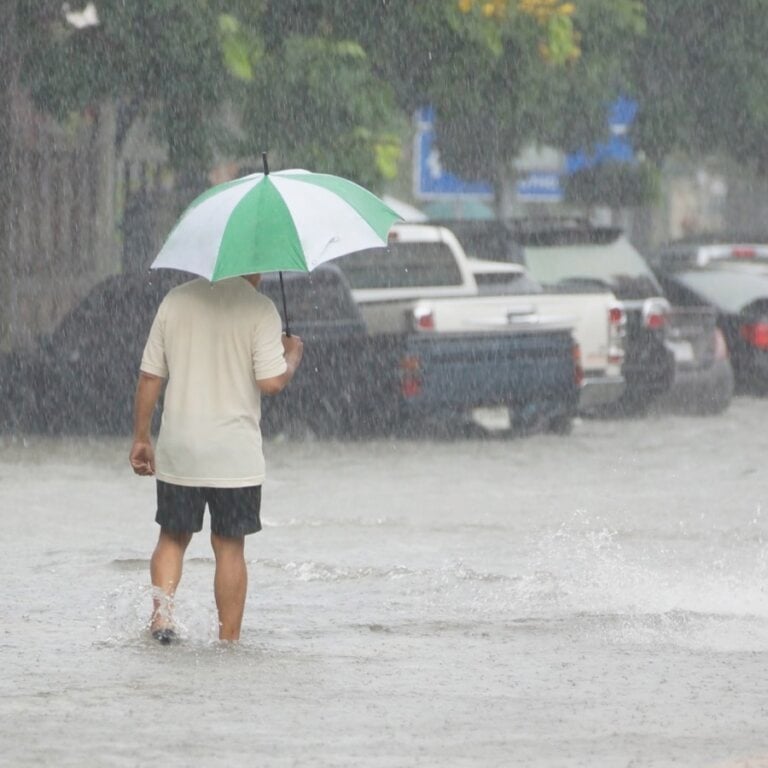
Rui- Joca: Ó Rafa, já viste o que chove lá fora? Joca: Hey Rafa, have you seen how it's raining outside?
- Rafa: Quê? Não te ouço. Deixa-me tirar os auscultadores… Rafa: What? I can't hear you. Let me take my headphones off...
- Joca: Olha para fora da janela. Até te vais passar. Joca: Look out the window. You'll freak out.
- Rafa: Eh pá! Que dilúvio. Está mesmo a chover bastante. Rafa: Oh man! What a deluge. It's really raining hard.
- Joca: Até parece que o mundo vai acabar. Joca: It seems like the world is going to end.
- Rafa: Alguma vez viste uma tempestade assim? Rafa: Have you ever seen a storm like this?
- Joca: Até agora nunca tinha visto. Joca: I never had until now.
Premium Members get access to this episode's entire transcription, as well as hundreds more!
Vocabulary
arrastadodragged sing. masc. atravessarto cross atéeven, until, up to os auscultadoresheadphones a camisolasweater, jersey, jumper choverto rain corajosobrave sing.,masc. os danosdamage, damages medricaschickens, people who get scared easily o periquitoparakeet o telhadoroof a tempestadestorm o tempoweather


Expressions
Caluda!Shut up! Alguma vezEver, at one time Que chaticeHow annoying, What a bummer, What a pain Até à dataTo date, To this day Lá foraOutside, Out there Força!Go ahead!, Go for it!, Do it! até agoraso far, until now
Premium Feature: Smart Review
With a Premium Subscription, you can save these phrases to Smart Review, and use spaced repetition to commit them to long-term memory.
Premium Feature: Episode Quizzes
With a Premium Subscription, you can take episode quizzes to challenge your comprehension skills and track your progress!







Comments
até te vais passar
is this an idiom?
Yes, it is! Something like “you’re going to freak out” or “it’ll blow your mind”, in English 🙂
Does the word camisola mean raincoat as well as sweater?
‘Camisola’ only means ‘sweater’. ‘Raincoat’ could be an ‘impermeável’, ‘sobretudo’ or ‘kispo’ (brand name turned common noun), for example.
Olá – I’m still going round and round in my head with when to use the future subjunctive, and the title of this shortie came back to me. Instinctively I would have said “até que a tempestade passar”. Would that be wrong? Many thanks for any help you can give me!
Olá! About the future subjunctive in general, you may or may not have seen this Learning Note before: Future Subjunctive | Practice Portuguese.
There are cases where the subjunctive appears due to structural triggers in the sentence, and this shorty’s title is one such example. Due to the addition of the word ‘que’, we are required to use the subjunctive subsequently. If the word ‘que’ were omitted, we could then keep the infinitive, without any difference in meaning or emphasis between the two options. It’s basically a random choice 🙂
– Até que a tempestade passe = Até a tempestade passar
Many thanks for that Joseph 🙏. Really interesting, but in fact my question was about the future subjunctive, not the infinitive. Is there any reason why the future subjunctive could not have been used here instead of the present?
There are a lot of subtleties in this area!
Got it. It’s still about structural compatibility (although I wouldn’t be able to tell the reason why these specific patterns/rules exist). The word ‘até’ on its own only accepts the infinitive; ‘até’ + ‘que’ accepts the present subjunctive or, in a past context, the imperfect subjunctive, but not the future subjunctive. To allow for the future subjunctive, you’d need to rephrase the sentence. For example:
– Enquanto a tempestade não passar
– Quando a tempestade passar
– …
Ah, so it’s just one of those rules. Makes perfect sense – and this sort of thing is what makes learning the language frustrating and delightful in equal measure.
The alternative construction with the infinitive was interesting too. Muito obrigado..