 Joseph
 Rui
RuiPlease request our permission before redistributing these files.
Premium Feature: Transcript Downloads
With a Premium Subscription, you can also download PDF transcriptions, with or without English translations for printing or offline use.
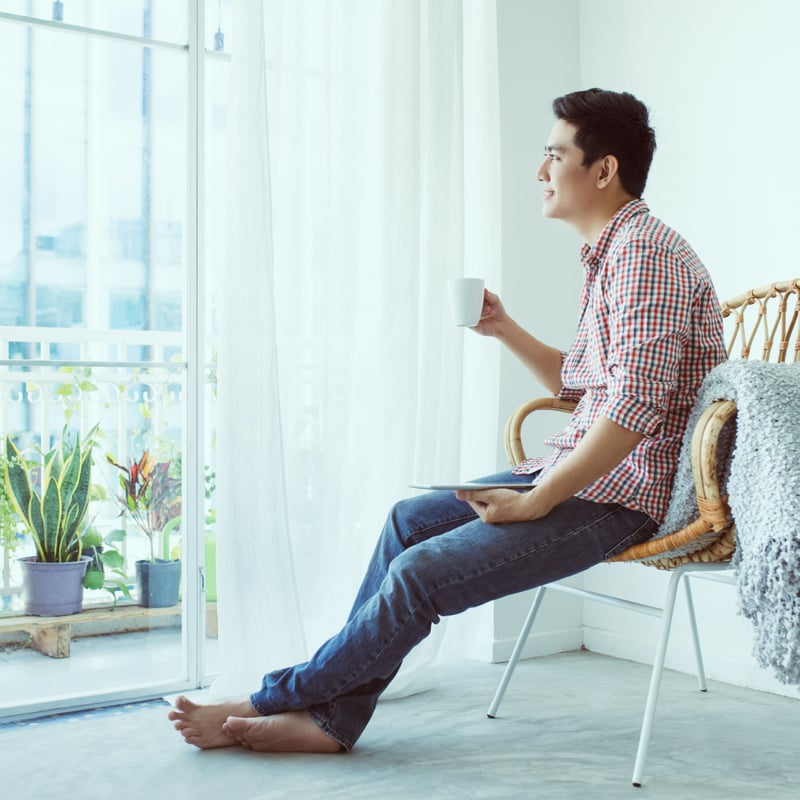
- Diogo: O que eu mais gosto na tua casa Diogo: What I like most about your house
- é que as janelas são grandes e deixam entrar is that the windows are large and they let in
- muita luz natural. a lot of natural light.
- Marco: Sim. Marco: Yes.
- Mas pode ser um problema quando estou a trabalhar But it can be a problem when I'm working
- no portátil, na secretária do meu quarto on my laptop, at the desk in my room,
- ou na sala. or in the living room.
Premium Feature: Episode Quizzes
With a Premium Subscription, you can take episode quizzes to challenge your comprehension skills and track your progress!
acenderto light, ignite, turn on apagarto turn off, put out, extinguish, delete aquecimentoheating, warming-up barbearto shave brilhantebrilliant, bright, shiny CamaBed Os candeeirosThe lamps a casa de banhobathroom a coisaThing os cortinadoscurtains, drapes a decoraçãodecoration deixarto let, to allow, to leave something demorarto take time, last, linger entrarto enter excetoexcept faltalack fecharto close, shut fotografiasphotographs IguaisEqual, same, alike o interruptorlight switch o invernowinter as janelaswindows ligarto call on the phone, connect, turn on a luzlight LâmpadasLight bulbs máquinamachine a máquina de barbearelectric razor os paisparents a paredewall a portadoor o portátillaptop quadrospictures, frames, paintings QuartoRoom, bedroom sairto leave, go out, exit salaroom, living room o secador de cabelohair dryer a secretáriadesk a televisãotelevision a tomadapower socket


Expressions
às vezessometimes junto anext to, beside, alongside, near prestar atenção a pay attention to 
Premium Feature: Smart Review
With a Premium Subscription, you can save these phrases to Smart Review, and use spaced repetition to commit them to long-term memory.





Comments
Hi Rui and Joel
I’m a good few weeks in to Practice Portuguese now, and it’s helping me so much! I find it so user friendly and the content is very entertaining. Keep up the good work!
Best wishes
Geraldine
Uma pergunta no quiz pede ‘ ‘Atingir o ecrã do portátil ou da televisão?’ Deve ser atingir ou ler?
Olá! “Atingir” está correto, se considerarmos que o sujeito implícito na frase é “a luz”. Sob essa perspetiva, o problema é a luz atingir o ecrã. Noutra perspetiva, também podemos dizer que por causa da luz, a pessoa tem o problema de não conseguir ler o que está no ecrã 🙂
I am finding it very good. One suggestion would be to have a new vocabulary page with each new section. I have started to write the new words down on a pad, but a reference page would be helpful.
Thanks Barak, you’re right. It says “e outro junto à cama”, instead of “e um junto à cama”. We’ll make the change!
Excellent episode! There are lots of useful words. Thank you!
In Lesson 1 there is the phrase “O pátio precisa de ser limpo”. My Spanish sensibilities may be messing me up here. Since limpo is an adjective describing a condition, if feels like the verb should be estar. Then again the English translation is “…cleaned.” So, ser would be part of a passive construction…but then I would want to say “…precisa de ser limpado”. Is there some strangeness about the word “limpo” in particular that makes its past participle look/feel like an adjective? Or is there a more general principle that I’m missing? Thanks!
Olá! The verb limpar has two past participle forms:
– Regular: limpado
– Irregular: limpo
Regular past participles are used with the auxiliary verb ter to form compound verb tenses, e.g. past perfect. But to form the passive voice, we use irregular past participles with the auxiliary verb ser. That’s why we have “ser limpo” (correct) and not “ser limpado” (incorrect). This Learning Note covers this topic in more detail: Double Past Participles
very funny!! This one made me LOL🤣The image that arises when Marco says:”Não consigo ligar o secador de cabelo e a máquina de barbear ao mesmo tempo..” 😂 That guy is a real multitasker!!!
Great episode! Just wanted to mention that I encountered the expression “prestar atenção a” for the first time in this episode. You might consider adding it to the vocabulary page…
Glad you liked it! We just added the expression “prestar atenção a”. Thanks for your feedback!