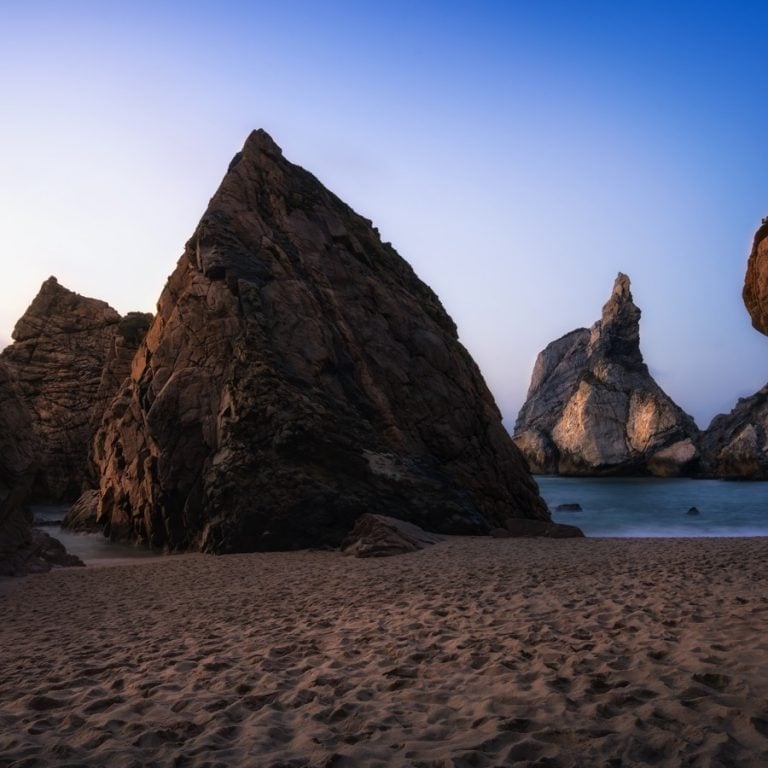
- Junto ao Cabo da Roca, em Sintra, Next to Cabo da Roca, in Sintra,
- fica situada uma das mais belas praias portuguesas is located one of the most beautiful Portuguese beaches
- e a mais ocidental da Europa. and the westernmost in Europe.
- Duas grandes rochas, a Ursa: que dá o nome à praia – e o Gigante, Two large rocks, the Ursa: which gives the beach its name – and the Gigante,
- esperam quem se arrisca a percorrer o trilho de acesso. wait for those who risk traversing the access trail.
- Reza a lenda que, há milhares de anos, Legend has it that thousands of years ago
- vivia naquele sítio uma ursa com os filhos, there lived in that place a (female) bear with her children,
Premium Members get access to this episode's entire transcription, as well as hundreds more!
Vocabulary
abandonarto abandon arriscarto risk, take a chance DifícilDifficult enfurecidoAngered, enraged, infuriated milharesthousands OcidentalWestern o paraísoparadise percorrerto traverse, roam, cover perigosodangerous masc.,sing. a praiabeach RecusadoRejected RochaRock RochedoLarge rock, boulder selvagemwild SituadoLocated, situated o sítioplace, site o trilhotrail UrsaBear (female)


Expressions
Reza a lendaLegend has it devido abecause of, due to Beira-marSeaside aquando deat the time of, when during Junto aonext to Tal comoSuch as, Just like, As well as
Premium Feature: Smart Review
With a Premium Subscription, you can save these phrases to Smart Review, and use spaced repetition to commit them to long-term memory.
Premium Feature: Episode Quizzes
With a Premium Subscription, you can take episode quizzes to challenge your comprehension skills and track your progress!
People João
João
João







Comments
Muito bom! Precisei de procurar a definicao de “falesia” no Google Translate.
Hi. As usual my lack of grammar knowledge confuses me. Why do we have use of terão sido and terá recusado? I thought that would been they will have been and will have refused. Why aren’t one of the simpler past tenses used? Thanks.
This is a rather literary construction we call “futuro composto” or “futuro perfeito” (future perfect). It can be used to describe past events with a certain level of doubt or uncertainty, as if you were saying that things allegedly happened that way. It fits in this context, because this is a legend, not necessarily a 100% real story 🙂
Is there a lesson on futuro composto?
Not yet, but it’s on the list. 🙂
Can you explain why the future perfect tense “terá recusado” is used here? Thanks!
Ah, yes, I’ve just explained it in another comment here, haha. Quoting myself: “This is a rather literary construction we call “futuro composto” or “futuro perfeito” (future perfect). It can be used to describe past events with a certain level of doubt or uncertainty, as if you were saying that things allegedly happened that way. It fits in this context, because this is a legend, not necessarily a 100% real story :)”
In the last paragraph……que assim se conservou devido ao…. is translated as ….that has been preserved due to…
Can you tell us why the simple past is used here?
Is it possible to use either … que assim tem se conservado devido/ que foi conservado?
You could say it either way 🙂 “Que assim se conservou”/”que foi conservado” to simply say that its natural wild state was preserved (until today) or “que assim se tem conservado” to highlight the fact that this action/process is carried over into the present and future, even though it started in the past. In Portuguese, this feels more like a matter of where to put the emphasis than a real practical difference in meaning.
Gostamos imenso desta praia, obrigada!
É muito bonita! E com o Cabo da Roca ali pertinho 🙂
Obrigada Joseph, é muito claro e útil.