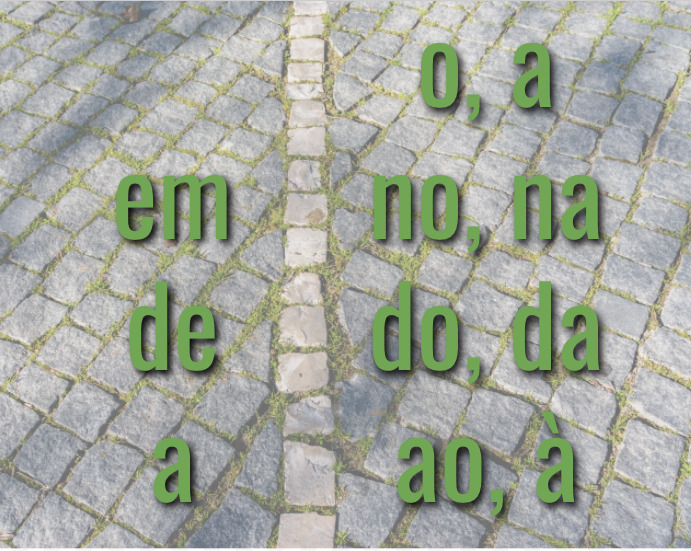
Remember definite articles? They’re the little words that mean the in Portuguese. They correspond to the gender (masculine or feminine) and number (singular or plural) of the item in reference, so there are 4 possibilities: o, a, os, and as.
However, it’s not always as simple as just replacing the with o, a, os, or as. Ready for a deep dive?
Separate or Contracted
First of all, keep in mind that definite articles can form contractions with prepositions.
- with a – ao/à/aos/às
- with de – do/da/dos/das
- with em – no/na/nos/nas
- with por – pelo/pela/pelos/pelas
For example, in some contexts, the preposition emin, at, on, about appears by itself (em florin bloom ), and in others, it is contracted with a definite article in the form of no, na, nos, or nas (no fornoin the oven ).


The Translation is Not Always Literal
Furthermore, Portuguese and English (and other languages) do not always utilize definite articles in the same way. Portuguese sometimes requires a definite article where English doesn’t, and vice versa. For example:
Eu sou do CanadáI am from Canada
A diversidade enriquece a vidaDiversity enriches life
O meu tio chega no domingoMy uncle arrives on Sunday
Next, we’ll go through a number of different contexts to describe how/when to use definite articles.
Common Nouns
When referring to specific instances of things, people, and objects, you usually use a definite article.
Os livros estão na mesaThe books are on the table
A sobremesa está boaThe dessert is good
Não gosto dos gatosI don't like the cats
Vamos no carroWe'll take the car (We'll go in the car)
With these examples, you’re referring to a specific set of books (the ones that are on a specific table), a specific dessert (maybe the one in front of you), a specific set of cats (maybe the ones that have been meowing outside your door for 3 days), and a specific car (the one in your driveway).
But you typically would not include an article when making a more generalized statement:
Não quero sobremesaI don't want dessert
Eu gosto de gatosI like cats
Vamos de carroWe'll go by car
Now you’re referring to cats and dessert, in general. You don’t want any type of dessert. You generally like all cats. You’re indicating the mode of transportation you’re going to use to get somewhere, but not referencing any particular car.
A common exception is the use of the noun casa, which means home or house:
Ela gosta de dormir cá em casaShe likes sleeping here at home
Esta noite fico em casaTonight I'll stay home
Deixei as chaves em casaI left my keys at home
Even though you’re referring to a specific house, an article is generally not used when referring to one’s own home. The meaning is more focused on the general concept of ‘being at home’, rather than on which particular house it is. There are other contexts in which you can use the article with casa, though, such as:
Vocês estão na casa delaYou (pl.) are at her house
Fico na tua casaI stay at your(sing.,inf.) house
When it comes to people, articles are often used to indicate the person’s gender. For example:
o caixathe cashier, teller (masc.)
a caixathe cashier, teller (fem.)
o agentethe agent, officer (masc.)
a agentethe agent, officer (fem.)
→ Quick reminder to help you avoid a common mistake: “a” is an indefinite article in English, but it’s a definite article in Portuguese. So “a mesa” is “the table”, not “a table”. 😉
Proper Nouns
In Portuguese we use articles before proper nouns, such as people’s names and brand names.
Eu sou o João. Ela é a Ana.I am João. She is Ana.
O João falou comigoJohn talked to me
Fomos jantar ao McDonald'sWe went for dinner at McDonald's
The vocative case is an exception. (In other words, when you use someone’s name to address them directly.) The name usually appears isolated by a comma at the beginning or ending of a sentence:
Olá, Ana!Hi, Ana!
Eduardo, chega aquiEduardo, come here
Places
It gets more complicated when it comes to the names of places, as the rules are not very consistent.
The vast majority of cities and towns are not preceded by articles, but some are, and there are even situations in which the article is optional.
- Visitei Évora e LisboaI visited Évora and Lisboa
- Vou a LisboaI'm going to Lisbon – this is the preposition a, not the article a
- Chegámos hoje de CoimbraWe arrived today from Coimbra
- Vou ao PortoI'm going to Porto
- Ela vive em Cardiff, no País de GalesShe lives in Cardiff, in Wales
- Passei pelo EntroncamentoI passed through Entroncamento
- Fiquei nas Caldas da RainhaI stayed at Caldas da Rainha – This one would also be correct without the article: Fiquei em Caldas da Rainha
You’ll notice that most of the cities that do get a definite article are those with names that are also common nouns. For example:
- o Porto – porto means port/harbour
- o Entroncamento – entroncamento means junction
- a Figueira da Foz – figueira means fig tree
But it’s just a pattern, not a rule. Place names that are plural common nouns often do not get an article. For example, even though torres means towers, we say Vivo em Torres VedrasI live in Torres Vedras . Porto Santo, as well as cities/towns with the words castelo, vila, or ponte in the name often don’t get an article either.
Bodies of water (such as rivers and lakes), elevations (such as mountains and hills), parks, and forests are always named with a proper noun and do get an article.
A Maria nadou no GuadianaMary swam in the Guadiana
Fomos até à Serra da EstrelaWe went to Serra da Estrela
Regarding the names of countries, we discuss some patterns in this Learning Note: Where Are You From?
Positions
When indicating specific positions of people or objects, you’ll use em (without the article) for on top or bottom (down/under), but you’ll use à (preposition a + definite article a) if you want to refer to something to the left or right.
O livro está em cima da mesa.The book is on top of the table
O vizinho vive lá em baixo, no rés-do-chãoThe neighbour lives down there, on the first floor
A televisão está à esquerda da lareiraThe TV is to the left of the fireplace
O teu carro está à direitaYour car is to the right
Emotions or States of Being
When describing emotions or states, you can use a verb + the preposition em on its own, without an article.
Ela está em choqueShe is in shock
Eu estou em stressI’m stressed
Nós estamos em pulgasWe’re very excited, Literal – We're in fleas (i.e. jumpy)
Time & Seasons
We can use articles with seasons and days of the week. It can appear combined with the preposition em in the forms of no/na/nos/nas. With months, however, most of the time we simply use the preposition em.
A minha estação do ano favorita é o invernoMy favorite season of the year is winter
No verão eu uso calçõesIn the summer I wear shorts
Detesto as segundas-feirasI hate Mondays
Vamos realizar um evento importante na sexta-feiraWe're holding an important event on Friday
Em março do ano passado, eu estava no BrasilIn March of last year, I was in Brazil
When referring to a certain hour, i.e. at a particular time, we often use the definite article a/as.
Vou chegar às 4:30 da manhãI'm going to arrive at 4:30AM
Ele saiu por volta da uma da tardeHe left around 1:00 in the afternoon
If you’re simply stating the time, no article is needed since we’re using the verb ser:
São cinco da tardeIt's 5:00 in the afternoon
This is true when taking about the past or the future, too: Eram cinco da tardeIt was 5:00 in the afternoon , Vão ser 5:00 da tarde daqui a poucoIt will be 5:00 in the afternoon in a bit
One exception is noon. Rather than saying 12 da manhã or 12 da tarde, we say o meio dia and a meia noite:
A tarde começa ao meio-diaThe afternoon begins at noon
Depois da meia-noite, é um novo diaAfter midnight, it's a new day
As with hours, we don’t need an article when using the verb ser with seasons, months and days:
Ontem foi sexta-feira, amanhã é domingoYesterday it was Friday, tomorrow it's Sunday
É julho e ainda faz frioIt's July and the weather's still cold
Ainda era invernoIt was still winter
Possessive Determiners & Pronouns
Using a definite article before possessive pronouns allows us to make an important distinction between objects of the same type.
- Aquele carro é meuThat car is mine – Emphasizes that the car is mine, not yours
- Aquele carro é o meuThat car is mine – Emphasizes that that particular car, not the other car, is mine.
Regarding possessive determiners, an article (or a demonstrative determiner) is almost always present. In certain sentences, such as Falei com seus filhos ontemI spoke with your children yesterday , it is technically optional, but it’s easier and less confusing to default to using an article in such contexts.
Eu falo pelos meus colegasI speak for my classmates
There are also situations in which the possessive determiner comes after the noun, and the definite article comes before the noun. These sound more poetic and are more commonly found in written texts:
Nos momentos meus…In moments of mine…
The article is sometimes dropped if we’re referring to something that’s not specific or undefined, like things, for example:
Deitei fora coisas tuasI threw out things of yours(sing.,inf.)
If we used an article, it would be Deitei fora as tuas coisasI threw out your things , which would sound more specific and would imply ‘all of your stuff’.
Also keep in mind the vocative exception (mentioned above) when it comes to possessives.
Minha querida mãe, não se preocupeMy dear mother, do not worry
Minha mãe functions as vocative, so the possessive ‘minha‘ doesn’t have an article behind it.