A substantivo (noun) is basically a person, place, or thing. When we think of nouns, we tend to think of vocabulary words. But before we go adding a bunch of Portuguese words to your vocabulary, we have to get some boring really fun stuff out of the way first…
Gender & Number
In Portuguese, every noun has a gender: masculine or feminine. If you’ve never studied a Romance language before, this may seem strange at first. Believe it or not, Old English used to use gender in a similar way, but it fell out of use over time.
And by number, we just mean singular or plural. Often, you can simply add -s to make something plural. We’ll get into more detailed rules later. 😉
Here’s why all this matters: many Portuguese words change form depending on the gender and number of the noun they’re connected to.
The first place you’ll notice this is with articles: the little words like the and a/an that often sit in front of nouns.
Articles


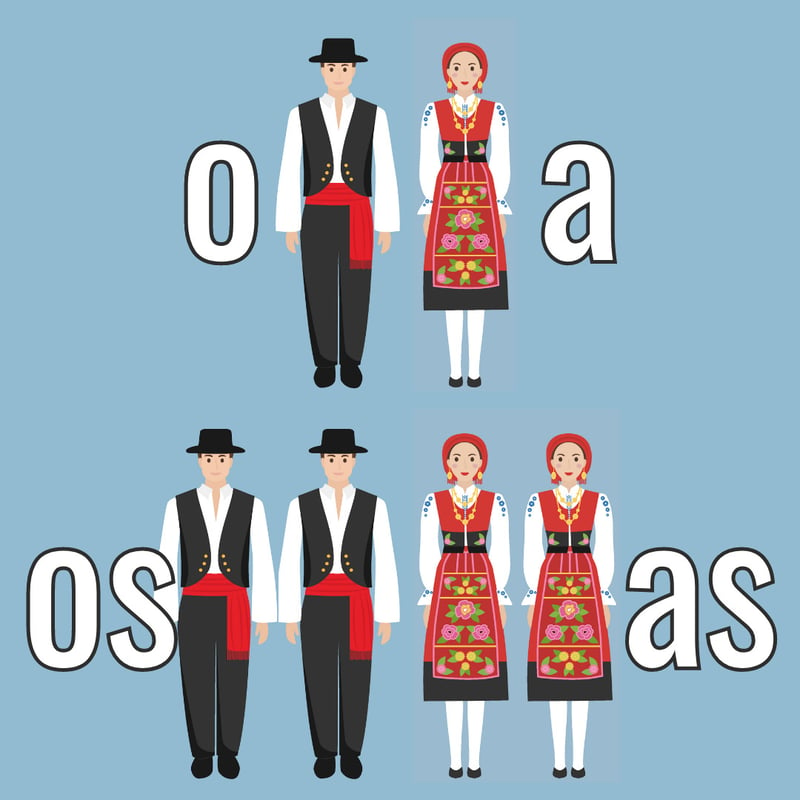
Here are the artigos definidos (definite articles): othe athe osthe asthe


- masculine, singular: o carrothe car
- masculine, plural: os carrosthe cars
- feminine, singular: a mesathe table
- feminine, plural: as mesasthe tables
And here are the artigos indefinidos (indefinite articles): uma umaa unssome, a few umassome, a few
- masculine, singular: um carroa car
- feminine, singular: uma mesaa table
- masculine, plural: uns carrossome cars
- feminine, plural: umas mesassome tables
Most words ending in o are masculine. Most words ending in a are feminine. (But as always, there will be exceptions!)
How Do I Use Articles in Portuguese?
Portuguese and English are two different systems. Sometimes they overlap, as in:
- Não tenho o carroI don't have the car – referring to a specific / already mentioned car
- Ela lê um livroShe reads a book – referring to an unspecified book
But other times they don’t, as in:
- Eu sou a AnaI am Ana – before a person’s name, in most contexts
- o CanadáCanada – before certain country names
- Sou dentistaI'm a dentist – no article needed when stating your profession
- uns livrossome books | umas vezesa few times – plural forms
Over time, small details like these will become intuitive, so don’t bother memorizing upfront. For now, just keep in mind that using articles (and using the language generally!) is about more than just translating each word.
→ For a deep dive into using definite articles, read more here.
A Quick Note About Learning Vocabulary
When we introduce individual vocabulary words throughout the Units, Shorties, etc., we will usually include the definite article, as such:
a palavraword
It’s more efficient to learn the gender at the same time you learn the noun. But to avoid lots of unnecessary repetition in vocabulary lists, the English translation will usually not include the word “the”.