



Portuguese has several advérbios de lugaradverbs of place to indicate the relative position of a person or object. These are particularly useful to learn: cá aqui aí ali lá acolá . In short, cá and aqui both mean here. Aí, lá, ali, and acolá mean there. Below we’ll explore the finer differences between each of these words.


Here and There
In Portuguese, here and there are a bit more complicated because we make a distinction between how close things are in relation to the speaker and listener:
- Here – Close to the speaker: aqui or cá
- There – Close to the listener: aí
- There/Over there – Far from both the speaker and listener: lá, ali, or acolá
Let’s take a look at each group in more detail.
Aqui vs. Cá
AquiHere(exact) and cáhere(general) are used when talking about things close to the speaker. While aqui is commonly used in both Portugal and Brazil, cá is, for the most part, specific to European Portuguese. Some people will use them interchangeably, but in theory, cá is less specific than aqui. Take these sentences, for example:
- A minha família está cá.My family is here. – When you use cá to talk about people, you might simply be saying that your family is in the same country or town as you are (e.g. cá em Portugalhere in Portugal )
- A minha família está aqui.My family is here. – In contrast, if you use aqui, it can imply that your family is much closer to you — in the same room or building, or even right next to you (e.g. aqui ao meu ladohere by my side )
Let’s explore a few more examples with each word individually:
Aqui
Aqui designates the exact spot where the speaker is, regardless of the listener’s location, so you could think of it as “in this place” or “right here”.
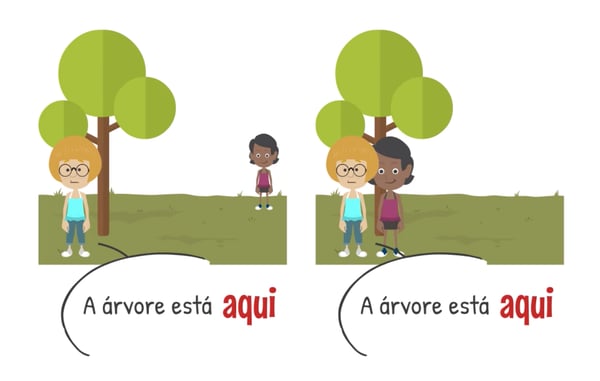
Other examples:
Fico aqui à tua espera.I’ll be waiting for you here.
Ele deixou aqui o chapéu.He left his hat here.
Cá
Cá, meanwhile, conveys a more general location, rather than a single, precise spot. It is similar to saying, “over here”.

Other examples:
Cá janta-se às oito em ponto.Here we have dinner at 8pm, sharp.
Está cá a mãe da Carolina.Carolina’s mom is over here.
In these examples, the speaker is referring to something inside a larger, yet well-defined, area – in this case, a house.
Expressions Using Aqui and Cá
Setting aside the guidelines mentioned above, it’s also helpful to know a few common expressions using these words:
Anda cáCome here
Chega aquiCome here, Come closer
Cá estamos nós!Here we are!
Aí vs. Ali vs. Lá
Aí, ali, and lá all translate to “there”, but similarly to the relationship between aqui and cá, they differ in specificity.
When something is in a location far from you, but close to your listener, you use aíthere (specific, close to listener)
When it’s far from both of you (i.e. out of sight or reach), you use alithere (specific, far from both) or láthere (general, far from both)
Aí
Aí means “there”, but is limited to the exact location of the listener.
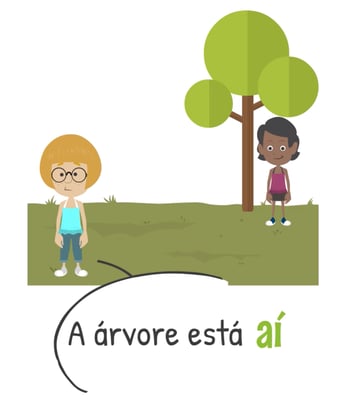
Other examples:
Bela mochila que aí tens .Nice rucksack you’ve got there.
Ela deixou o livro dela aí.She left her book there.
Ali
Elas esperaram ali por eles.They waited there for them.
Lá
Lá refers to a more general area, instead of a single spot. Like acolá, it can be interpreted as “over there”. However, lá usually refers to an area out of sight.
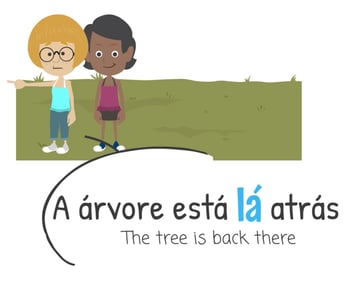
Other examples:
Lá neva muito.It snows a lot over there.
Deixei as minhas malas lá.I left my bags over there.
Once again, in these examples, we’re referring to something in a larger area – in the first example, a country or region, and in the second example, a building or place.
Acolá
Acolá has a more old-fashioned or literary tone, so in daily life it’s not heard as often as ali and lá. It also refers to things far from both the speaker and listener.
AcoláThere, Over there sometimes serves as a contrast to aqui or ali when referencing two different locations. For example:

Aqui temos café, acolá temos sumo de laranja.Here we have coffee, and over there we have orange juice. .
Podes montar o cavalete ali e meter os pincéis acolá.You can set up your easel there and your brushes over there.
Review
Whew! That was a lot. Let’s go over how to say here and there in Portuguese one more time before we practice in the lessons.
- Here
- aqui = here in the exact location of the speaker
- cá = here in general
- There
- aí = there in the exact location of the listener
- There/Over There
- ali = there/over there, a location far away from both, but still visible/accessible
- lá = there in general, far away from both, often not visible/accessible
- acolá = over there, a location far away from both (less common)
Comments
My head hurts.
It’s definitely a tricky topic! Let me know if we can answer any questions. For the most part, it just takes time to get used to all these variations. You’ll see them come up in the Shorties a lot, so that will give you an idea of how they are used in context.
🙂
Thank you so much for writing this article! Cleared up my question on which one to use when
If there is one tree kinda far away, is one able to use ali OR acola interchangeably?
Hm, yes, you could use both. But “ali” is more commonly used than “acolá” 🙂
loooooool, I am going to join your club
For the saying “Aqui vou ser feliz” can you say “Vou ser feliz aqui”?
Noticed a few times you place the adverb before the sentence and others at the end.
Thanks
Yes, you can. The two sentences are by all means the same 🙂
Olá Rui & Joël
Some asked a similar question but I need confirmation:
Aqui temos café, acolá temos sumo de laranja.
Temos café aqui, temos sumo de laranja acolá.
What’s the most natural order in Portuguese. Or are both orders used normally?
Olá, Amadou. Both orders would be fine to use and would sound natural. However, ‘acolá’ is not commonly used in everyday conversation. We’re more likely to just say “ali” instead of “acolá” 🙂
I think I understand all the explanations, but then the examples don’t match up. If “Acola” is “acolá = over there, a location far away from both” how is the orange juice over there “Acola”? Surely the orange juice is still in the same room? I am totally lost now.
Both are correct. But the second is more usual.
What about além? How does this word fit in with these others above?
The word além is similar to ali. Let me also note that both words have a directional feeling than the word lá doesn’t possess, i.e. when you want to indicate/point in a certain direction. Let me clarify with an example:
– Onde está a Sara? Ela está ali. = Onde está a Sara? Ela está além. = Where’s Sara? She’s over there.
We couldn’t simply say “Ela está lá” in this context. At best, we could use “lá” in a more extended sentence where the word is actually used more for emphasis than for actual value, e.g. “Ela está lá em França” (She’s in France – note how the word “lá” doesn’t add anything to the essential meaning and disappears in translation).
In this context of positions, the word além can also mean beyond/past, in which case, it should appear paired up with the preposition para. For this particular use, the word is interchangeable with the word “lá” (hope this isn’t too confusing!).
– A aldeia fica para lá do monte. = A aldeia fica para além do monte. = The village is beyond the hill. / The village is past the hill.
Excellent instruction as always.
I do have a pronuciation question.
Que is usually pronounced (kĕ) as I understand it.
However, in the sentence Bela mochila que aí tens the pronunciation of que aí was key aye ….the que took on the same sound as the french qui.
Do I have this correct? Does the pronunciation of que sound like the french qui when it comes before a word that starts with a vowel or diphthong?
Any insight greatly appreciated.
Olá. Good question – and you basically answered it yourself. The E in ‘que’, by default, sounds very closed. But when it’s followed by a more open vowel, this E is typically pronounced like an ‘ee’ at normal speed. That’s what happens in that example (“…que aí tens”), where the A of “aí” modifies the vowel just before.
These pronunciation variations are addressed in this Learning Note: Pronunciation Variations
I’ve seen ‘next door’ translated as both aqui ao lado and aí ao lado. Is there a subtle difference here along the lines next-door-to-me-here and next-door-to-you-there? Or is this just an example of multiple ways of saying the same thing?
Olá! “Next door” per se only means “(porta) ao lado”. In a context where the other house is equally close to the speaker and listener, the choice to use “aqui” or “aí” is basically up to the speaker and has no practical significance. It just depends on what they subjectively interpret as being close or more distant at that moment 🙂
In an online spoken European Portuguese site , they say alí is used with things : “the restaurant is over there”, whereas lá is used with people: “ she is working there for 2 months”. Can you comment on this?
Hi Doug!
I wouldn’t say it works exactly like that…
“Ali” refers to something that is right there, over there, at plain sight. A place or something you can point or at least point the way to. It’s more specific of the space that you refer to. “Where is the book?” “Right there/over there on the table.” / “Ali na mesa.” You’re actually able to point the way to the book. You’re being specific about the location of the book.
“Lá” is more generic. It’s somewhere that you can’t see from where you are, some place you’re referring to without actually seeing it. And also a location that isn’t precise. “Is the book in the other room?” “Yes, it’s there on the table.”/”Sim, está lá na mesa.”
Also, when you say “She has been working there for 2 months.” if you’re pointing to the place where she works it would translate to “ali”. However, if you’re talking to someone about the place where she works (being out of sight) it would translate to “lá”.
Portuguese is a very tricky language, isn’t it?
Cheers,
Luís
Thank you. So I would say based on your answer, the difference between alí and lá is not “things” versus “persons”, but rather “there, in sight” and “ there, out of sight”. Alí and lá can therefore refer to things or persons. Correct? (Pimsleur described the difference as persons versus things, but based on everything I’ve read, they are not correct, and you confirmed that).
Yes, both are adverbs of place and may be used in sentences referring to both things and persons. Don’t get too limited on the “in sight”/“out of sight” though, because it may have a few nuances. But that’s a good way to start understanding the difference between these two adverbs!
These are somewhat theoretical subtleties that even native speakers do not always respect. My advice for beginners is not to get too complicated with this at this level.
I don’t understand the translation of this sentence:
Fico aqui à tua espera.
it looks something like “I stay here to your wait” to my (beginner) eye. Why not use the verb esperar here instead of what appears to the be noun for wait?
This learning note might interest you: https://www.practiceportuguese.com/learning-notes/the-preposition-a/
The sentence “Fico aqui à tua espera” could also be phrased “Espero aqui por ti”, if that makes more sense to you. Either way is perfectly correct! 🙂
my eyes are bleeding
I hear you Caramba. Not sure if this will help you, but i’ll share a simplified system i use quite successfully in everyday life. Successful in the sense that people understand me, though stricly not alqaus correct 🙂 i say:
– Aqui for “here” except when saying i live here, then i use cá.
– Ali for “there” except when talking about people and things in other places then i use lá.
Probably this is correct about 80% of the time. For the rest i just trust that i’ll get the hang of “aí” eventually. But right now, safe to say that sound doest exactly trip off my tongue! And truth be told i dont want to think that deeply every time i open my mouth 🙂
Reming me my learning Japanese, there are almost the same nuances about (here, there next to you, other there) 😛
One of the exercises in the next lesson has the English sentence “You don’t live here”, which it translates to “Tu não moras aquí.” Could we also say “Não moras cá” with no great change in meaning?
Yes! “Não moras cá” is a perfectly fine alternative 🙂
I’m Portuguese Tutor on Preply and this article help me a lot when I need to explain aqui, lá, etc to my students, thank you all!
Hi Joseph. Absolutely loving this app. Thank you for all the perfectly worded explanations!
One question RE the above: Can “Aqui temos café, acolá temos sumo de laranja” be used when describing customs in different countries? Eg: Aqui (em Portugal) temos café, acolá (na Austrália) temos sumo de laranja.
Olá e muito obrigado!
It’s preferable to use ‘lá’ in that context. ‘Acolá’ doesn’t really fit in that scale of distance 🙂
It seems that all words here that end in “i” refer to a specific location, but all words ending in “á” refer to a general location, regardless of distance 🙂
Olá! Yes, that’s a good way of looking at it, and I think it can certainly help people decide which one to use. Or, at least, reduce the number of options.